Last updated: September 17, 2026 · 10–12 minute read
Custom Cushion Quality Control Checklist Before Shipment
Reliable cushion quality control starts before final inspection. The strongest system links the approved sample, current specification, incoming materials, first-off review, in-process checks and shipment inspection to one clear acceptance reference.
Quality control compares finished custom cushions with an approved, documented reference.
Quick answer: what should be on a custom cushion QC checklist?
A custom cushion QC checklist should verify approved product information, material codes, finished dimensions, construction, workmanship, filling, attachment, labels, SKU count, packing and carton marks. It should state the sample reference, measurement points, visual standards, defect definitions and who is responsible at each stage.
Inspection is most useful when it follows a decision made earlier. A final inspector cannot determine whether a seam, colour or fit is acceptable if the buyer never approved a clear reference.
1. Set the quality reference before production
Create one current approval pack: purchase order, drawing revision, material list, golden sample or signed photographs, measurement table, cover detail sheet, packaging plan and defect definitions. Name the product and SKU clearly. If a material, dimension or construction changes, issue a controlled revision and make sure obsolete records do not reach the production line.
The golden sample should represent final materials and construction wherever possible. A development sample made with substitute fabric can prove shape, but it must not silently become the bulk reference. Our sample process guide explains how to control this handover.
2. Check incoming materials before cutting
Confirm cover fabric supplier code, colour, print or pattern direction, foam or filling reference, zipper, piping, labels, thread, hardware and packaging components. Compare these with the approved pack. Record lot or roll information where it matters to visual continuity. If an alternative is proposed, stop and obtain written buyer approval before it is used.
Incoming checks are a practical factory-testing point. They prevent later inspection from discovering that a correct cushion was made from an unapproved component. For printed or directional covers, check artwork revision and fabric orientation before cutting begins.
3. Approve a first-off piece
A first-off is the first completed unit made under the bulk production method. Compare it with the approved sample before the main run proceeds. Check dimensions, cover tension, seam and piping quality, zipper operation, fill profile, pattern direction, attachment, label placement and packed presentation. Record the result and any correction.
For sectional, curved or fitted cushions, inspect a complete set or representative assembly. A single piece may not reveal mismatched sections, uneven pattern direction or installation problems. The first-off stage is the efficient place to stop a repeated error.
Typical first-off inspection points
- Size, thickness, curves and cut-outs at agreed measurement points.
- Correct cover, fill, trim, zipper, label and attachment materials.
- Seam quality, piping joins, corner shape, print or fabric direction.
- Fit on representative furniture and comfort/profile where relevant.
- SKU identity, care information and packing configuration.
4. Use in-process checks to prevent repeated defects
In-process quality control focuses on operations that become expensive to correct later: cutting direction, panel matching, seam placement, fill quantity, zipper installation, attachment reinforcement and label application. The factory should identify who checks these points and how deviations are recorded. For a buyer, the essential issue is traceability: does the production team know which approved requirement applies?
Define visible workmanship standards in practical terms. Examples include unacceptable loose threads, stains, oil marks, untrimmed corners, uneven piping, obvious puckering, incorrect pattern placement or damaged zippers. Use approved photos where helpful. Avoid vague instructions such as “high quality” without an observable benchmark.
5. Conduct pre-shipment inspection against the same pack
Pre-shipment inspection confirms finished goods, quantities and packing before release to the forwarder. Review a suitable sample of finished cushions according to the agreed inspection plan. Check visual appearance, dimensions, workmanship, material identity, label and SKU accuracy, accessories, individual protection, carton count and carton marks. Open cartons to ensure the packed product matches the documents.
If a third-party inspector is used, send the approval pack before the appointment. Include measurement instructions, defect definitions, expected quantity and packing details. The inspector should not invent quality limits independently; their report should state what reference was used and what was found.
6. Review packing and shipment readiness
Packing quality affects customer experience and claims risk. Confirm correct item identification, individual protection, compression or recovery instructions, carton configuration, carton condition and shipping marks. For sectional cushions, verify orientation labels and installation map. For retail pillows, verify hangtags, barcode labels and presentation in addition to outer carton protection.
Take photos of representative finished goods and open cartons as part of the shipment record. Retain the inspection report, packing list and approved sample information. These records are useful for receiving teams, claims analysis and reorders.
PROJECT SUPPORT
Need a project-specific cushion QC checklist?
Send your drawing, product type, material references and destination. We will help organise the approval, first-off and shipment points to define before production.
Request a Quality Checklist →7. Handle defects with a clear decision path
Agree how defects are classified and resolved before inspection. A critical safety or wrong-SKU issue is not the same as a minor trim inconsistency. Record the defect, quantity affected, photos, root cause where available and corrective action. Decide whether goods are reworked, sorted, replaced or accepted with a documented concession.
Use each issue to improve the specification or first-off check for the next order. Repeated problems often point to unclear dimensions, missing visual examples, weak material control or a gap between buyer approval and line instruction. The objective is prevention, not blame.
Common QC mistakes
- Starting inspection without an approved sample or current specification.
- Checking finished appearance but not incoming material codes.
- Skipping first-off approval on a custom construction.
- Leaving measurement points and tolerances undefined.
- Asking an inspector to make brand or design decisions without a reference.
- Ignoring labels, packing and carton marks until after goods are loaded.
Build a defect library that production can use
Quality language becomes more useful when supported by examples. Maintain a small library of approved and unacceptable photos for common custom-cushion issues: uneven piping, wrong pattern direction, loose threads, puckering, stains, incorrect labels, poor fill distribution and damaged packing. Each image should identify the SKU, location, decision and relevant requirement. This helps new operators, inspectors and third parties use the same visual standard.
Do not use the library to create an unrealistic zero-variation promise. Use it to identify which variations are meaningful for the buyer’s product and which are within the agreed sample reference. The goal is consistent judgement, not a vague demand for perfection.
Close corrective actions before the next release
When a defect is found, record the affected SKU, quantity, operation, photo evidence, immediate containment action and proposed root cause. Then state what will change: a clearer drawing, material check, sewing instruction, first-off check, operator training or packing method. Confirm the result on the next relevant production point rather than assuming an explanation alone solved the issue.
For repeated custom orders, include prior corrective actions in the pre-production handover. This gives the factory an opportunity to prevent a known issue before it reaches shipment inspection and gives the buyer evidence that quality feedback is being acted upon.
Review quality data after delivery
After receiving goods, compare the shipment report with site feedback, damage claims and installation observations. If an issue appears after delivery, determine whether it relates to product construction, packing, transport or installation. Link the finding to the SKU and approved reference. This is more useful than a general supplier rating because it identifies the process point that needs improvement.
Use the review to update the next order’s checklist and sample approval. Over time, this creates an E-E-A-T signal in the content itself: the process reflects real project learning, not just generic inspection terminology.
Turn the approved sample into an inspection standard
Quality control becomes more consistent when every team works from the same accepted reference. Before bulk production, assemble a practical quality pack: approved sample photographs, dimensional table and tolerance, fabric or finish code, seam and piping reference, fill or foam direction, label artwork, packaging method and the list of defects that are not acceptable for this product. The pack should be understandable to the people who cut, sew, fill, inspect and pack the cushions, not only to the sales contact who negotiated the order.
Define what is checked at each stage. Incoming material review can confirm the delivered fabric, trim, labels and inserts match the released codes. First-off inspection can check the earliest finished pieces against the sample before the order moves too far. In-process checks can focus on recurring risks such as panel orientation, dimensions, stitch quality, cover fit and correct components. Final inspection and shipment inspection can check visual appearance, quantity, labels, cartons and packing list. The exact sampling level is a buyer-and-supplier decision, but the checkpoints should be agreed before the factory is under shipping pressure.
Use a clear defect language and correction loop
Vague comments such as “poor quality” rarely help a production team correct work. Record the issue, SKU, quantity affected, location on the product, photograph, expected reference and corrective action. For example, “front panel print rotated relative to approved sample” is clearer than “artwork wrong”; “piping join visible at front-left corner” is clearer than “sewing issue.” The factory can then decide whether to rework, replace, segregate, investigate a process cause or request buyer approval for a limited variance.
Track whether a correction has been verified. If the same issue appears again, review the production instruction rather than simply adding another final-inspection check. A recurring wrong label may be a pack-out handover problem; inconsistent fit may be a cutting or insert-specification question; shade concerns may require better lot separation or approval controls. This feedback loop turns QC from a last-minute sorting exercise into a way to protect the approved product through the full order.
Make shipment inspection a documented buyer handover
Before release, compare a representative selection of packed goods with the approved file: SKU, dimensions at agreed points, cover construction, visible material, labels, quantity, carton marks, packing count and documents. Check that replacement or sectional components are clearly identified and that the packing list reflects the actual cartons. If an external inspection is requested, share the relevant product references in advance so it assesses the buyer’s requirements rather than a generic description.
Retain the inspection record, corrective-action notes and final approved references with the order. They provide evidence for receiving, customer service and reorders without suggesting that an inspection can guarantee every future use condition. A connected QC process is credible because it explains what was controlled, when it was checked and how deviations were handled.
Review quality data after the order, not only before dispatch
After delivery, review the order record with the buyer-facing and factory teams. Compare sample issues, production corrections, inspection observations, packing feedback and any receiving comments by SKU. Look for patterns: a problem isolated to one material lot, one size, one sewing detail or one packing configuration is more actionable than a general statement that the order was difficult. Assign a practical improvement owner and add the accepted change to the product file before a repeat order is quoted.
This review also gives the customer a transparent service path. If an issue is reported, ask for product identifier, photos, location, use condition and timing, then compare it with the released records. A fact-based response is fairer to both sides than guessing from a broad description. It reinforces that quality is controlled through clear requirements, evidence and correction—not through unqualified promises.
Keep customer requirements visible on the factory floor
For a complex order, post a controlled production summary at the relevant workstations: SKU, approved material and face direction, key dimensions, construction image, label reference and packing instruction. Ensure only the current revision is available. This simple visual handover reduces reliance on memory between cutting, sewing and packing, while giving inspectors an immediate reference when they verify the first pieces.
Conclusion: quality is a connected process
Custom cushion QC works when every stage refers to the same approved product. Define the reference, confirm materials, approve first-off, prevent repeated defects, inspect shipment and keep records for receiving and reorders. This gives B2B buyers a more credible and manageable way to protect quality.
Photography plan for this guide
Use original factory photography where possible. The prompts below are production references for realistic imagery, not claims about a specific order.

Position: Below the introduction
Caption: Quality control compares finished custom cushions with an approved, documented reference.
AI prompt: Photorealistic documentary factory photography in Shenzhen: Asian quality inspector measuring a finished tailored seat cushion and reviewing a simple non-readable checklist, clean organized workstation, authentic fabric and piping detail, natural industrial lighting, no logos.
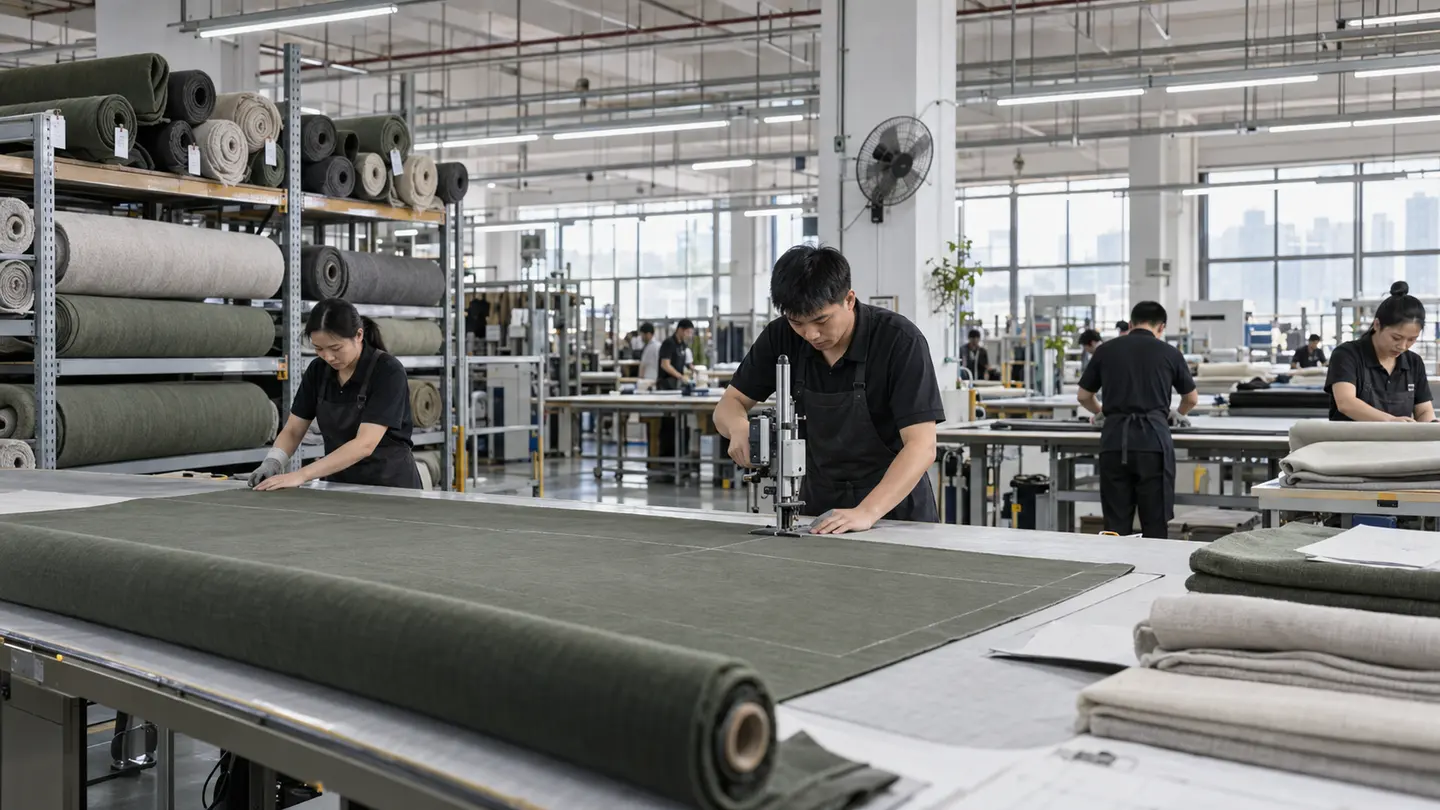
Position: After “Check incoming materials before cutting”
Caption: Fabric code, direction and cut preparation are verified before production begins.
AI prompt: Realistic Shenzhen soft-furnishing factory scene: Asian textile technician comparing upholstery fabric roll to a small fabric swatch at cutting table, visible directional pattern, clean industrial setting, no readable text or logos.

Position: After “Review packing and shipment readiness”
Caption: Finished cushions are counted, protected and checked before carton release.
AI prompt: Photorealistic export packing inspection in clean Shenzhen factory: finished custom cushions in protective bags beside plain cartons, Asian staff with clipboard checking count, natural industrial light, no logos or readable text.
Frequently asked questions
What is a first-off sample?
A first-off is the first finished unit made using the bulk production method. It is compared with the approved reference before the main production run proceeds.
What should a third-party cushion inspector receive?
Provide the approved sample or photo record, drawing, material list, measurement points, tolerances, defect definitions, SKU quantities, label requirements and packing plan before inspection.
How do I check cushion dimensions?
Measure at the points and condition defined in the approval pack. State how length, depth, thickness, curves and cut-outs are measured so factory and inspector use the same method.
Why check materials before cutting?
Incoming material confirmation prevents an unapproved fabric, fill, trim or label from becoming a bulk-production issue. It is easier to correct before cutting than at shipment.
What records should be kept after shipment?
Keep the approved specification, material references, sample photos, first-off and inspection records, packing list, shipment photos and any corrective-action notes for reorders or issue analysis.
Enquiry popup plan
Trigger: Show after 40% scroll, after 30 seconds on page, or on desktop exit intent; suppress after a completed submission.
Popup title: Request a cushion QC checklist
Copy: Share your product and project requirements. We will send the approval, material and inspection fields to clarify before bulk production.
Fields: Required: Name, Email. Optional: Company, Project Type, Message. Do not request a phone number.
Button: Request QC Checklist
Put one clear quality reference behind your cushion order
Email info@cushionnook.com or use the enquiry form to discuss sample control, factory checks and pre-shipment inspection.
Send Your Requirements →