Last updated: September 17, 2026 · 10–12 minute read
Custom Cushion Sampling Process: From Drawing to Approved Pre-Production Sample
A well-run custom cushion sample process is the bridge between a buyer’s concept and repeatable bulk production. This guide explains what to send, what to inspect, how to control revisions and when a sample is genuinely ready to release for production.
A product developer compares a cushion prototype with fabric swatches and the current drawing revision.
Quick answer: what is a proper custom cushion sampling process?
A proper sampling process moves through a controlled sequence: clarify use and construction, issue a drawing and material brief, review factory assumptions, make a physical prototype, record changes, approve a final pre-production reference and use that reference for bulk quality control. The sample should be judged as a finished cushion on its intended furniture—not merely as a piece of fabric or a studio photograph.
For B2B buyers, the sample is a decision tool. It confirms whether the product fits, looks and functions as intended before bulk materials, labour and freight are committed. The goal is not to make extra samples; it is to make each revision answer a defined question.
1. Begin with a buildable brief, not an inspirational image
Images are useful for communicating style, but they rarely specify how a cushion must be made. A supplier needs finished size, thickness, shape, cover construction, filling, seams, closure, attachment and intended use. For fitted seat cushions, include photos and dimensions of the supporting frame. For a curved bench, a full-size template or carefully dimensioned drawing may be necessary. For printed pillows, state artwork scale, repeat, front and back placement and label position.
Describe the product application in plain language. Is it a removable hotel banquette cover? A restaurant booth seat exposed to frequent wiping? A poolside cushion that must dry after rain? A retail pillow with a branded insert card? These details affect fabric choice, seam placement, foam build, zipper access and packing. A vague brief creates a vague prototype.
Minimum information for a first sample request
- Dimensioned drawing or completed measurement sheet, with units and key tolerance points.
- Frame photos, templates or reference furniture measurements for fitted products.
- Cover material code, colour reference and performance or care expectation.
- Filling or comfort objective, thickness and whether the product is seat, back or decorative.
- Construction details: zipper, piping, ties, straps, non-slip base, quilting, labels and packaging.
- Destination market and any known customer, testing or documentation requirement.
The supplier should return a drawing review and an assumption list before sampling starts. If something is unknown, label it as a decision to be confirmed—not as an invisible substitution. Our supplier qualification guide explains how this discipline reduces buyer risk.
2. Confirm material availability before interpreting the sample
A prototype made in substitute fabric can prove shape or sewing method, but it may not prove final colour, cover tension, durability or appearance. The sample record should state whether every component is final: cover fabric code and colour, foam or fill, zipper, piping, thread, label and packing. If a temporary substitute is used, document exactly what it replaces and which performance or visual decision remains open.
Material confirmation is especially important for directional weaves, large repeats, outdoor textiles and custom printing. Pattern scale can alter cutting yield and seam placement; a different fabric weight can change how sharply a cushion holds its edge; a different zipper or piping diameter can affect fit. Keep material swatches with the approved sample and list the codes in the approval record.
For outdoor applications, discuss the whole moisture system rather than approving a cover in isolation. Seams, closure, underside, filling, drainage and care instructions determine how the complete cushion dries in service. See our quick-dry construction guide before finalising a sample for exposed seating.
3. Review the first prototype against measurable acceptance points
When the first physical sample arrives, review it in the intended context. Put a fitted cushion on the actual frame or a matching mock-up. Sit on a seat cushion. Open the zipper. Check that ties reach their fixing points. Look at pattern placement from normal viewing distance. A tabletop sample can conceal problems in fit, comfort and proportion.
Create a review sheet with pass, change and question columns. Use photos with arrows for visual corrections and measurements for dimensional corrections. For every requested change, identify whether it affects artwork, material, construction, unit cost, timing or packaging. “Make it better” is hard to execute; “move the zipper 30 mm away from the right-hand corner, use the approved 5 mm piping, and retain a 50 mm gusset” is actionable.
Common first-sample inspection points
- Finished length, width, thickness, radii and fit at the agreed measurement points.
- Cover tension, pattern direction, symmetry, seam alignment, piping joins and stitch appearance.
- Foam or fill distribution, comfort, edge profile and recovery after normal use.
- Zipper operation, removable-cover access, ties or straps, non-slip base and hardware placement.
- Artwork scale, print colour reference, label position, care information and packing presentation.
4. Control revisions with one current specification
Many sample failures are document failures. A buyer may approve one fabric by email, change a zipper in a call and correct a drawing in a marked-up PDF. Unless those decisions are consolidated, different people can manufacture against different versions. Maintain a simple revision-controlled specification with a date, revision number, approved drawing, bill of materials, measurement table, visual references and change log.
Each revision should have an explicit status: prototype only, revised sample requested, approved with conditions, or approved for bulk. Do not use “approved” if a major item such as final fabric, print proof or fitted installation is still open. If the change changes cost or MOQ, ask for written commercial confirmation before authorising the next stage.
For a multi-SKU collection, track samples by SKU rather than assuming a general approval applies to all sizes and colours. Shared construction can be approved once, but each pattern, size or printed artwork may need its own proof. The same discipline supports accurate MOQ planning later.
5. Turn the approved sample into a pre-production reference
The final approved sample, often called a pre-production sample or golden sample, should be the reference used by the buyer, factory and inspection team. It should represent the actual bulk material and construction wherever possible. Record its date, drawing revision, material codes, finished measurements and signed approval status. Store it cleanly and identify it so it is not confused with an earlier prototype.
Before the main run proceeds, the factory should compare a first-off production piece with the approved reference. This first-off check is a practical form of factory testing: it verifies that material codes, cutting, sewing, fill, trim and dimensions are translating into the intended result. If a difference appears, resolve it before more units are made. This is much more efficient than discovering a repeated deviation during shipment inspection.
PROJECT SUPPORT
Need a sample-ready cushion brief?
Send your drawing, frame photos, use case and material direction. We will help organise the details that should be confirmed before a prototype is made.
Start a Sample Review →6. Plan sample timing around real dependencies
Sampling time is not simply sewing time. It can include drawing clarification, sourcing a fabric cutting, making a print or embroidery proof, converting foam, sewing, filling, review, courier transit and a revision cycle. A custom material or special finish can add a separate supplier lead time. Build this into the project plan rather than asking the factory to compress every decision into the final week.
For a project with a fixed installation date, work backwards from shipment and include time for buyer review. Allocate time for a first prototype, a revision if necessary and pre-production sign-off. A short pause to correct the sample is usually less expensive than a shipment that fits poorly or uses an unapproved component. Read our lead-time guide for a buyer-facing schedule framework.
7. Use sampling to prepare inspection and handover
The sample approval should create the tools needed for shipment inspection. List the dimensions to measure, the visual workmanship points, the approved colour reference, accessories, labels, packed quantity and carton marks. If a third-party inspector will attend, provide this information before the appointment. An inspector cannot determine whether a slight variation is acceptable without a buyer-approved reference.
For fitted or sectional products, include installation preparation in the sample stage: orientation labels, numbered sections, attachment method, hardware count and a simple placement diagram. This is particularly useful for hotel benches, restaurants and modular outdoor seating where similar pieces can be mixed up at receiving. Our shipment inspection guide details the final handover checks.
Common sampling mistakes
- Approving photos while never checking the physical cushion on its intended frame.
- Allowing substitute materials to become bulk references without a documented final confirmation.
- Collecting changes across messages without issuing one current specification.
- Approving a general construction but overlooking different sizes, patterns or printed SKUs.
- Releasing bulk materials before unresolved sample decisions are commercially and technically confirmed.
- Using the sample for marketing only, rather than as the reference for quality control and shipment inspection.
Run an approval meeting that creates clear action
A productive sample review is a short decision meeting, not an informal reaction to a photograph. Prepare the current drawing, material swatches, prior revision list and intended frame or installation reference. Invite the people who own design, purchasing and operating decisions when possible. Review the sample in a fixed order: overall fit, dimensions, cover and colour, fill and comfort, construction details, labels, packing and unresolved commercial impacts.
For every comment, assign one of four outcomes: approved, change required, information required or not applicable. A change request should identify the exact location and expected result. For example, “approve cover fabric code A12; move zipper to underside; retain 50 mm gusset; confirm revised sample cost and date” is usable. “The cushion feels better” is a helpful observation but not a production instruction until the team identifies what changed.
Separate design approval from release approval
A sample can be visually approved while commercial or documentation items remain open. Keep those statuses separate. Design approval may confirm fit and appearance; production release confirms final material codes, quantity, price, packing, lead time and acceptance criteria. This distinction prevents a buyer’s positive design feedback from being treated as permission to cut bulk goods with unresolved components.
When several stakeholders review a sample, nominate one person to issue the consolidated approval record. The factory should not have to reconcile contradictory feedback from different emails. Store dated photos, annotated drawings and material swatches together, then send one current revision to the production and quality teams.
Plan a pre-production handover
Before bulk release, hold a short handover with the factory’s product developer, production lead and quality contact. Confirm which sample is the golden reference, where it is stored, what measurements are critical, which visual details need close review and what packing must be used. For custom fitted or sectional cushions, include the installation map. For printed pillows, include the artwork revision and placement rule.
This meeting creates a bridge between development and manufacturing. It also gives the buyer a chance to find mismatches between the approved sample and the purchase order before materials are cut. Record the outcome in the project file and use it as the basis for first-off and shipment inspection.
Know when another sample is worth the time
A second sample is usually worthwhile when a change affects fit, final material, print, filling, closure, weather behaviour or a visible tailored detail. It may be unnecessary when a correction is documented, low-risk and can be objectively checked on first-off. The decision should consider the cost of delay against the cost of producing an unapproved result. In custom B2B work, a clear additional sample is often cheaper than wide rework after bulk release.
Run a practical sample review, not just an aesthetic review
Sample approval is stronger when the people who will buy, install, merchandise or maintain the product see the same physical reference. Place the cushion on the intended chair, bench or sofa rather than judging it only on a flat table. Check finished length, width and thickness at agreed points; cover tension around corners; seam placement; zipper access; tie or fastening position; insert recovery; and how the cover sits after a person gets up. For throw pillows, check fill distribution, corner shape, print orientation and the position of labels. Photograph the review from repeatable angles and mark any observation against the sample revision.
Use a short approval form with three possible outcomes: approved for bulk, approved with named corrections, or not approved. Avoid an informal “looks good” email if there are unresolved details. A correction should state what changes, who owns it, whether a revised sample or photo is required and whether it affects price or lead time. If the buyer accepts a limited deviation because it is commercially reasonable, record that too. This is not bureaucracy; it gives cutting, sewing, filling and packing teams a reference that remains clear after the development meeting has ended.
Translate the approved sample into factory controls
Before bulk production, the factory should convert the sample into a production-ready file. It normally includes an approved drawing or measurement table, material codes, fabric face direction, cutting allowance where relevant, stitch and piping notes, insert specification, label artwork, packaging method and quality checkpoints. The team should identify which sample details can vary within an agreed tolerance and which must visually match the approved reference. For example, a soft fill may recover differently after transit, while a misplaced zipper or reversed print panel is a construction error.
A pre-production meeting is the right time to challenge ambiguity. Ask how the team will verify the first pieces, whether the intended material is available in the approved revision, how mixed sizes will be identified, and what happens if the original sample used a temporary substitute. If a customer provides a furniture frame or template, confirm that it is still the current version before cutting starts. These questions are especially important for shaped bench cushions, sectional sets and printed designs, where a small reference mismatch can be repeated across the order.
Use first-off and shipment checks to protect the sample decision
The approved sample should remain accessible throughout production. Compare a first-off bulk piece with it before the order is far advanced, then use the same criteria at in-process and shipment inspection. A buyer does not need to inspect every unit personally; the value comes from agreeing what will be checked, who records it and how nonconforming pieces are corrected. Ask for clear photographs of measurement points, construction details, labels and packed cartons alongside any agreed inspection record.
Finally, retain the approved sample record with the purchase order and final SKU reference. Repeat orders are faster and safer when the supplier can begin from a known product version, while still confirming any new fabric lot, label, packing or destination requirement. A disciplined sample process creates a dependable bridge from customer requirements to factory testing and shipment release.
Conclusion: a sample is a controlled decision record
The best sample process turns subjective preference into clear production instruction. Start with a buildable brief, name the real materials, inspect the physical item in its application, log each change, approve a final golden reference and connect it to first-off review and shipment inspection. This gives a B2B buyer a practical way to protect product quality without slowing development unnecessarily.
Photography plan for this guide
Use original factory photography where possible. The prompts below are production references for realistic imagery, not claims about a specific order.
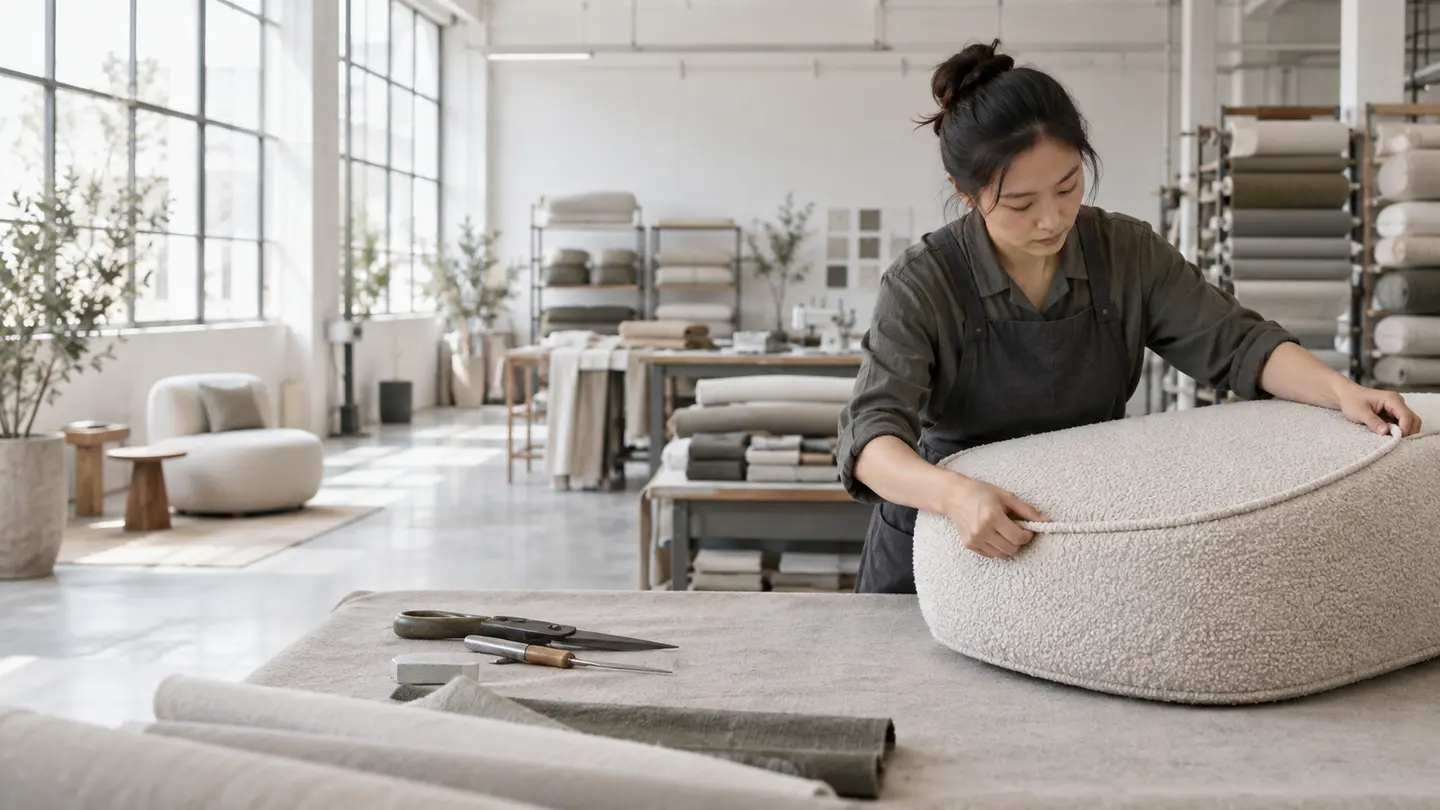
Position: Below the introduction
Caption: A product developer compares a cushion prototype with fabric swatches and the current drawing revision.
AI prompt: Photorealistic documentary photo in a Shenzhen cushion sample room: Asian product developer comparing a tailored custom cushion prototype, fabric swatches and dimensioned technical drawing on a clean worktable, soft natural light, authentic materials, premium B2B editorial photography, no logos, no readable text.
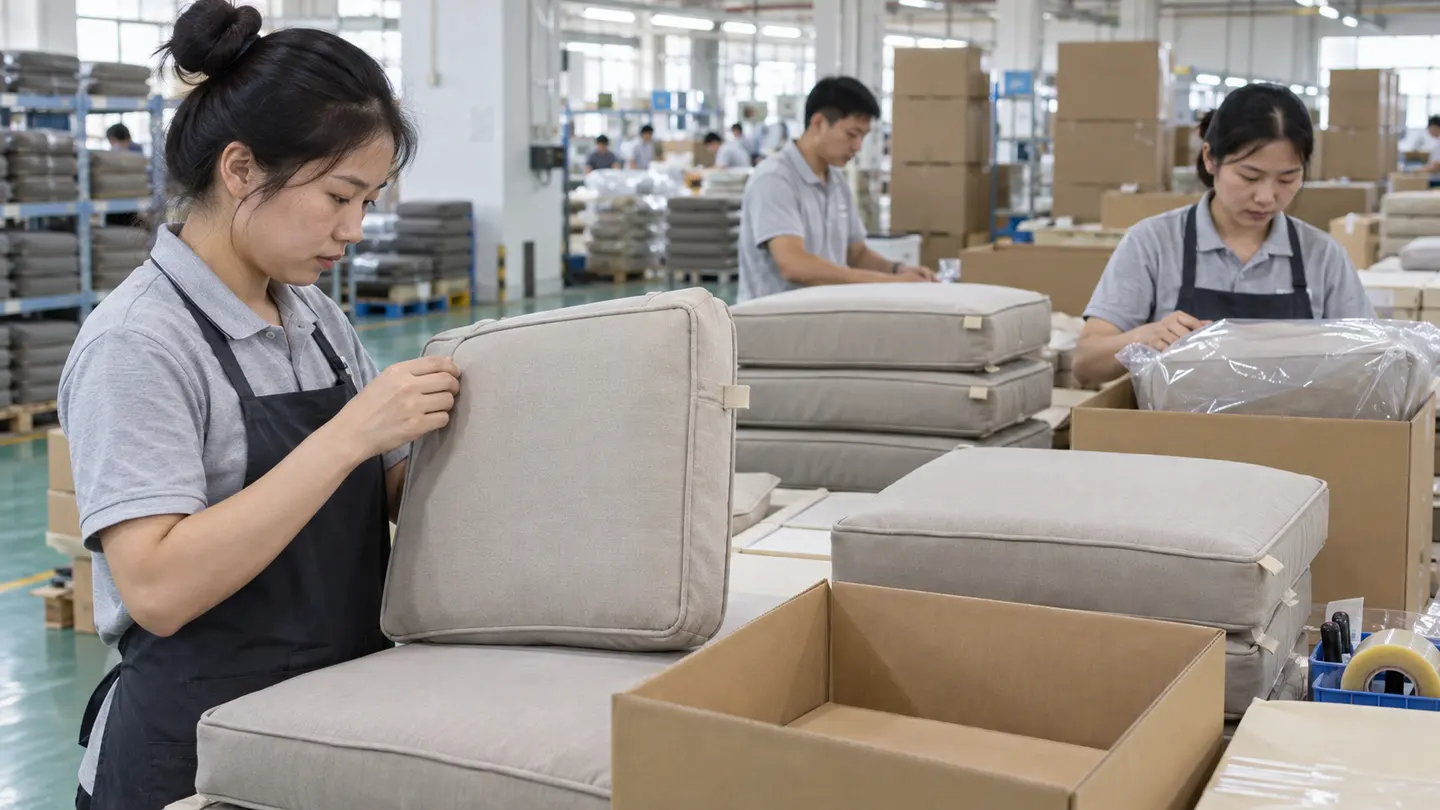
Position: After “Turn the approved sample into a pre-production reference”
Caption: A first-off production piece is checked against the retained approval reference before bulk release.
AI prompt: Ultra-realistic quality-control photo in a Shenzhen textile factory: Asian technician measuring a tailored seat cushion beside a retained approved sample and neutral checklist, clean bright factory lighting, visible stitching and woven texture, authentic documentary style, no text overlays or logos.
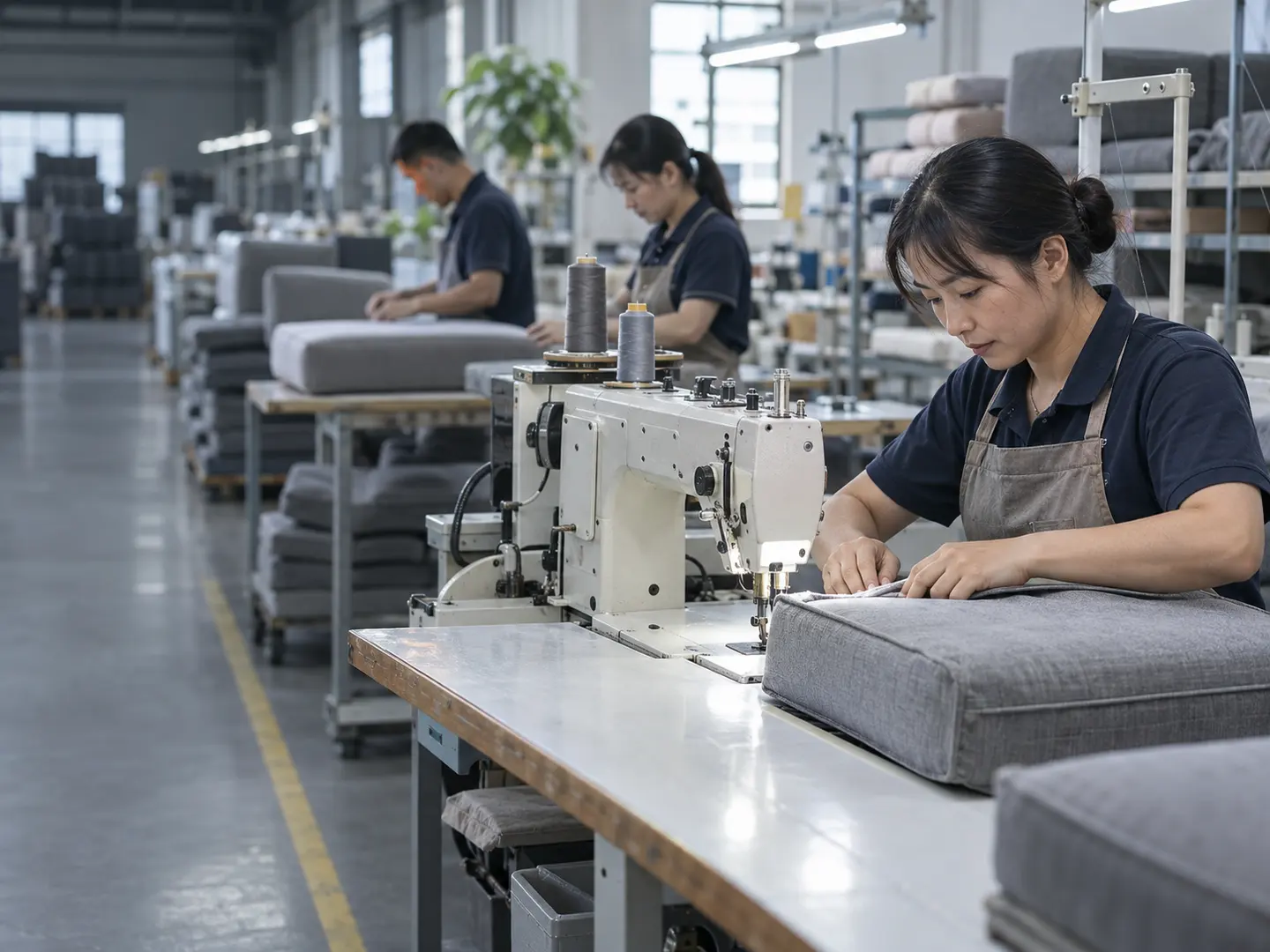
Position: After “Use sampling to prepare inspection and handover”
Caption: Approved sectional cushions are identified and protected for clear receiving and installation.
AI prompt: Realistic B2B factory dispatch photograph: several finished sectional custom cushions protected in clear bags with small non-readable orientation markers, Asian warehouse staff preparing plain export cartons, clean Shenzhen facility, natural industrial light, no brands, no readable text.
Frequently asked questions
What is the difference between a prototype and a pre-production sample?
A prototype explores shape, construction or concept and may use substitute materials. A pre-production sample should represent the final approved materials and construction and becomes the reference for bulk production and inspection.
Should a buyer approve a cushion sample by photo?
Photos are useful for communication, but they should not be the only approval for a custom fitted, comfort-critical, printed or detailed cushion. Review the physical sample on the intended frame whenever possible.
What should be included in a cushion sample approval sheet?
Include drawing revision, materials and codes, finished measurements, construction details, photos, change log, packing assumptions, approval status, date and the names of buyer and factory contacts.
Can bulk production begin while a material is still being decided?
It should not begin for affected components until the material and commercial impact are confirmed. If early work is unavoidable, document the risk and define exactly what can proceed without creating an unapproved substitution.
Who should receive the approved sample information?
The buyer, product developer, factory production and quality teams, and any third-party inspection team should use the same approved specification. The supplier should control obsolete versions so they do not reach the line.
Enquiry popup plan
Trigger: Show after 40% scroll, after 30 seconds on page, or on desktop exit intent; suppress after a completed submission.
Popup title: Start your cushion sample review
Copy: Share your dimensions, application and material direction. We will send the key information to confirm before sampling begins.
Fields: Required: Name, Email. Optional: Company, Product Type, Message. Do not request a phone number.
Button: Start Sample Review
Move from concept to an approved cushion sample
Email info@cushionnook.com with your project requirements or use the enquiry form to begin a controlled sampling discussion.
Send Your Requirements →