Last updated: September 17, 2026 · 10–12 minute read
Custom Cushion MOQ Explained: What B2B Buyers Need to Know
Custom cushion MOQ is not one fixed factory number. It is the practical result of material minimums, manufacturing setup, SKU complexity and packing choices. This guide helps B2B buyers request an MOQ breakdown they can use for product planning and supplier comparison.
Fabric, product samples and packing references are reviewed together before an MOQ is finalised.
Quick answer: what is the MOQ for custom cushions?
There is no universal MOQ for custom cushions. A workable minimum order quantity is usually constrained by the largest requirement among finished-product labour, cover fabric or colour, print setup, foam or filling conversion, custom trim, labels and export cartons. A simple repeat order in available materials may be viable at a much lower quantity than a new collection with custom-dyed fabric, several sizes and branded retail packaging.
Instead of asking only “What is your MOQ?”, ask a supplier to separate the minimum for each component and state what can be shared across SKUs. That turns an unhelpful headline number into a purchasing decision: which product features are driving the minimum, what can change, and what quantity makes the landed unit cost more sensible.
1. Separate product MOQ from material MOQ
The finished cushion MOQ covers the factory work needed to set up cutting, sewing, filling, inspection and packing. Material MOQs sit underneath it. A mill may have a minimum for a specific fabric colour; a printer may need a minimum run for artwork; a label supplier may require a batch size; and a carton supplier may have a practical minimum for a custom size. The highest of these constraints often becomes the real commercial minimum.
For example, a buyer may need 100 bench cushions, but the selected fabric colour may require more fabric than those 100 covers consume. The supplier may offer three choices: use an available stock colour, buy the full fabric minimum and keep balance fabric, or adjust the product mix so the remaining fabric becomes coordinated pillows or replacement covers. None is automatically best; the decision depends on launch plan, storage capacity and ability to use the residual material later.
Ask for this MOQ breakdown in writing
- Finished cushion MOQ by construction and size.
- Cover fabric minimum by material, colour and supplier.
- Minimum for printed, embroidered, quilted or specially finished covers.
- Foam, fibre, feather or quick-dry filling conversion constraint.
- Minimum for piping, zipper, woven label, hangtag, insert card and carton.
- Whether different SKUs can share fabric, foam, trims, labels or cartons.
Use a one-page enquiry with these fields. It is easier to compare suppliers when they are answering the same product brief rather than estimating from a mood board. Our quote-request guide lists the information a factory needs.
2. Why colour and fabric often determine the minimum
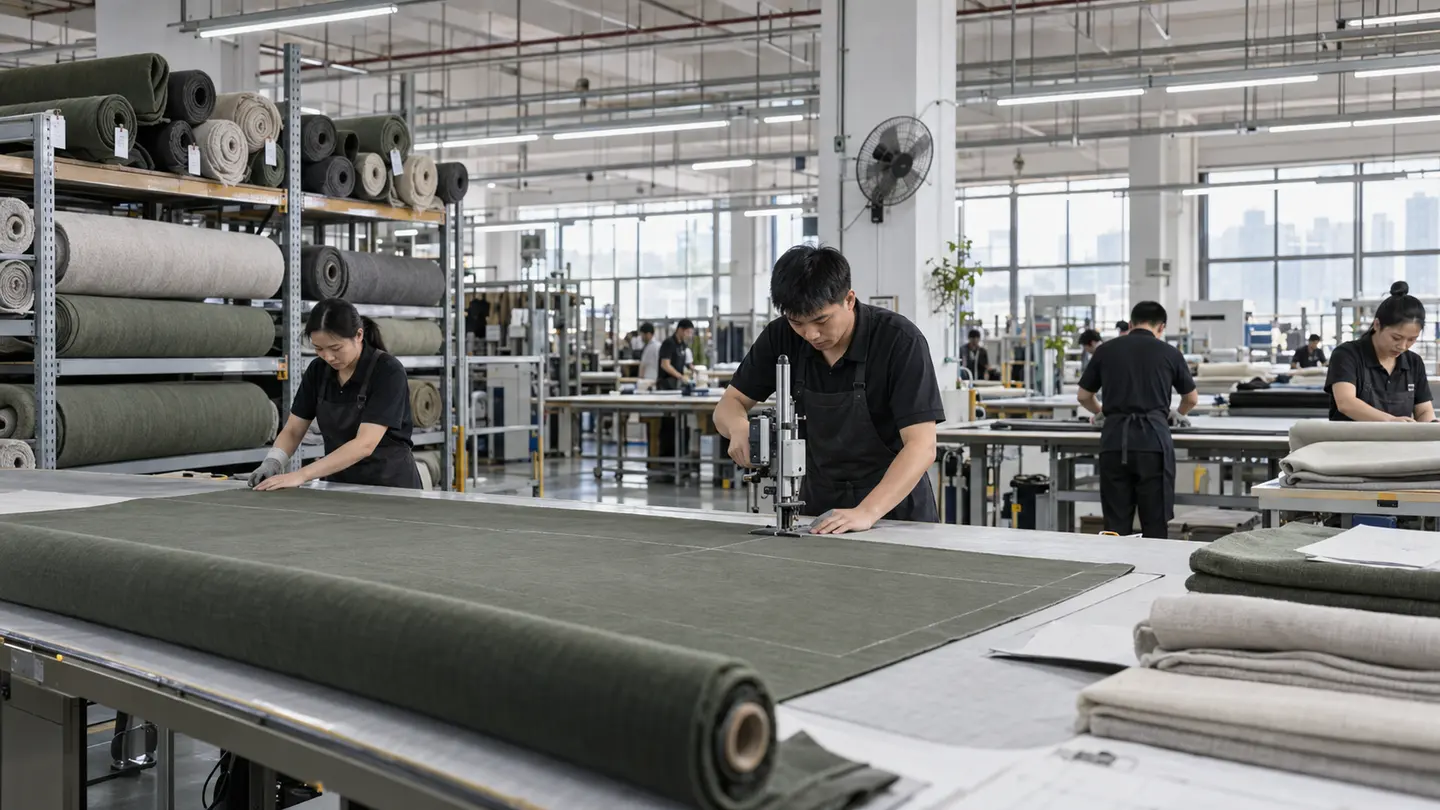
Fabric is frequently the main MOQ driver because the buyer is purchasing a colour, weave, print or finish—not merely square metres of cloth. Stock-supported ranges can allow smaller projects, while custom dyeing, special backing, performance finishing or a unique print repeat can add mill requirements and lead time. The fabric yield also matters: a wide, simple rectangular cushion may use material efficiently, while a narrow stripe, directional print, shaped gusset or large pattern repeat creates more cutting loss.
Ask the supplier to calculate fabric consumption per SKU with a stated allowance for seam, matching and waste. A quotation that simply says “fabric included” does not tell you whether the pattern placement has been accounted for. For patterned or printed covers, approve scale, repeat, direction and focal placement during sampling. Our custom printed pillow checklist explains why artwork decisions and MOQ are linked.
Where a launch quantity is modest, the lowest-risk route is often a selected stock fabric or a colour family with confirmed availability. That is not a compromise if the material still meets the application. It can free budget for a better sample process, removable covers or more protective packing rather than tying cash up in residual fabric.
3. SKU count changes complexity even when total quantity is unchanged
One order of 500 identical cushions is operationally different from 10 colours of 50 pieces each. The total quantity may look substantial, but each colour needs its own cutting control, material allocation, label count, packing separation and inspection sample. Multiple shapes add further setup because sewing steps, filling patterns, attachment points and carton dimensions change.
For a private-label collection, start with a hero SKU and a disciplined variation plan. Keep one cover construction, insert type, zipper position and carton family where practical, then vary colour, artwork or size only where it supports the merchandising strategy. That lets the factory consolidate materials and lets the buyer learn from a first run before expanding the assortment.
Ways to reduce MOQ pressure without changing the brand concept
- Share the same base fabric across several sizes or products, using a limited colour palette.
- Use one standard insert or foam build across a family and vary only the cover.
- Choose existing zipper, piping or label colours when the custom colour is not visually essential.
- Use a universal export carton or a simple carton label before investing in printed retail cartons.
- Phase a collection: approve core SKUs first, then reuse proven materials for the next release.
4. Distinguish a low MOQ from a commercially sensible MOQ
A supplier may agree to make a small order, but that does not automatically make it the right procurement decision. Small runs spread cutting, sewing, quality control and packing setup across fewer pieces. If the buyer also needs custom materials, the unit price may rise sharply and unused material may remain. The useful question is: at what quantity do setup, material use and freight work together for this product?
Request price breaks at quantities that match your sales or project forecast—for example, launch quantity, reorder quantity and a consolidated quantity. Ask the supplier to explain what changes at each break. The answer may reveal that one level releases a fabric minimum, one uses a fuller carton configuration, or one improves production efficiency. This is more informative than treating the lowest legal order quantity as the target order.
For hospitality or contract projects, a low MOQ can also create replacement risk. If a project has 80 bespoke seat cushions and the buyer expects occasional replacement, consider whether to buy a controlled overage, keep approved cover material, or establish a reorder path. The best choice depends on storage, colour-batch sensitivity and product life cycle.
5. Sampling, revisions and MOQ should be planned together
Sampling resolves the decisions that drive MOQ: final cover, colour, fill, trim, artwork and packing. Do not release bulk material before the physical sample is approved unless the commercial risk is understood. A sample change from a stock fabric to a custom colour, or from a plain cover to a patterned one, can alter both the MOQ and the lead time.
Keep the sample bill of materials. It should name fabric and trim codes, filling construction, labels and packaging assumptions. When the sample is approved, the supplier can confirm that the bulk quotation uses the same construction. If a sample uses temporary substitute fabric, write that fact into the sample record and obtain a second colour or material confirmation before cutting bulk goods. See our sample process guide for a detailed approval sequence.
6. Build a transparent MOQ table for supplier comparison
One of the most effective buyer tools is a simple table in which each supplier completes the same fields. Include finished MOQ, fabric minimum, custom-colour minimum, print minimum, label minimum, carton minimum, estimated material lead time, sample time, bulk production time and whether remaining material is retained for the buyer. Add a column for assumptions and exclusions.
Do not assume every supplier uses the same terminology. “MOQ” could mean per colour, per size, per order, per material or per carton. Confirm the unit explicitly. If the supplier says different cushions can be combined, ask exactly which elements can be combined and whether the price changes. Treat “mixed MOQ available” as a starting point for clarification, not a final commercial term.
PROJECT SUPPORT
Need an MOQ breakdown you can compare?
Send your sizes, cover material idea, quantity by SKU and destination. We will help identify the product, fabric, trim and packaging assumptions that should appear in the quotation.
Request an MOQ Breakdown →7. Include packing and freight in the MOQ conversation
Packaging is often deferred until late in development, but it can change the viable order. Cushion shape, filling recovery, individual protection, carton size and carton quantity affect both factory packing labour and freight. A decorative pillow collection may use compressed packing safely when the insert recovers as expected; a tailored foam seat cushion may need a different method to protect its profile and avoid prolonged compression.
Ask for carton dimensions, pieces per carton and an explanation of how the product is protected. If cushions are sectional, require SKU or orientation labels that make receiving and installation practical. For retail, decide whether branded inserts, hangtags or printed cartons are needed on the first run or can be phased after sell-through is proven. Our export and retail packaging guide covers these decisions.
8. Common MOQ mistakes B2B buyers can avoid
- Comparing a per-colour quote from one supplier with a total-order quote from another.
- Approving a fabric swatch without checking colour availability, width, repeat and minimum purchase.
- Adding custom labels, cartons or print after the production quantity is fixed.
- Launching too many low-volume colourways before a material and packing system is proven.
- Ignoring residual material ownership, storage and reorder use.
- Assuming a reduced MOQ has the same unit price, lead time or inspection control as a standard run.
The remedy is not more complexity. It is a disciplined, written breakdown that identifies which choices are fixed and which can be adjusted. Buyers can then protect the details that matter to the customer and simplify the ones that do not.
Use MOQ to design a lower-risk first order
MOQ is also a working-capital decision. Extra material can lower an apparent unit price, but it ties up cash, requires traceable storage and may be difficult to use when a colour, pattern or product specification changes. The useful objective is to buy enough for a reliable launch and a sensible reorder path—not to maximise quantity merely because a price break exists.
Separate three pools in the buying plan: goods intended for immediate sale or installation, a deliberate replacement or safety quantity, and residual material. Give the safety quantity a stated reason, such as replacement covers for a hotel installation. Label residual material by fabric code, colour, roll or lot where known, quantity, owner, storage location and intended use. Without this separation, balance fabric becomes an invisible cost rather than a usable reorder asset.
Choose the right first-order strategy
A new private-label range may benefit from a limited core palette in stock-supported fabric, one insert programme and flexible carton labels. A hotel project may prefer a controlled spare-section quantity and retained material references for maintenance. An outdoor range may combine seat and back SKUs so one cover-material minimum is used productively. Each approach has a different commercial logic, but all make MOQ visible rather than treating it as an unexplained supplier rule.
Ask suppliers to show what changes at each proposed level—such as 100, 250 and 500 units. Does the change release a fabric minimum, improve cutting yield, spread setup time, fill cartons more efficiently or reduce freight volume per unit? A clear explanation helps procurement and finance teams evaluate the real trade-off instead of comparing only a unit price.
Residual-material agreement questions
- Who owns balance fabric, trim or labels after the first order?
- How will it be labelled, stored and protected from mix-up or damage?
- How long will it be held, and are storage terms documented?
- Can it serve replacement covers, coordinated SKUs or only the original item?
- What happens if a later material lot differs in shade, finish or availability?
Put the answer in the purchase order or a commercial attachment. This is especially valuable for custom colours and prints, where a modest balance can matter for future repairs or extensions. It also protects the factory from being expected to store undefined material indefinitely.
Review a low-MOQ offer responsibly
A low-MOQ offer can be viable, but it deserves specific questions. Is it based on available material, a shared production run, a reduced cover specification, a development substitute or a different packing plan? Does it include the same label and inspection control as a larger run? Is the material available for reorder? These questions do not reject low MOQ; they make sure its terms match the buyer’s intended product.
Keep the final MOQ breakdown with the approved sample and quotation. At reorder time, the team can see which constraints were material-specific, temporary or capable of improvement. The first order then becomes useful operational information rather than a one-time negotiation.
Conclusion: use MOQ as a product-planning tool
MOQ is a design, supply-chain and commercial decision in one. The right question is not simply “What is the minimum?” but “What minimum is created by this material, SKU plan, construction and packing choice—and what happens if we change one of them?” When buyers separate each constraint, use a representative sample and compare complete quotations, they can launch a custom cushion program with fewer hidden costs and a clearer path to reorder.
Photography plan for this guide
Use original factory photography where possible. The prompts below are production references for realistic imagery, not claims about a specific order.

Position: Below the introduction
Caption: Fabric, product samples and packing references are reviewed together before an MOQ is finalised.
AI prompt: Photorealistic B2B product-development photography in Shenzhen, China: Asian product developer at a clean table with custom cushion samples, neutral fabric rolls, swatch cards, plain carton mock-up and calculator, natural daylight, premium editorial realism, authentic textile textures, no logos, no readable text, 16:9.
Position: After “Why colour and fabric often determine the minimum”
Caption: Fabric width, pattern direction and cutting yield influence the usable quantity from each material run.
AI prompt: Ultra-realistic documentary photo inside a Shenzhen cushion factory: Asian textile worker aligning upholstery fabric on a cutting table with simple paper pattern pieces, visible woven texture and directional stripe, organized industrial environment, natural overhead light, no logos, no text overlays.

Position: After “Include packing and freight in the MOQ conversation”
Caption: Protected finished cushions are grouped into plain export cartons for a shipment-readiness review.
AI prompt: Realistic factory dispatch photo in Shenzhen: finished custom seat cushions protected in clear bags beside plain export cartons, Asian warehouse employee checking packing count with a clipboard, clean well-lit staging area, accurate soft-furnishing textures, no logos or readable text.
Frequently asked questions
Can different cushion sizes be combined to meet MOQ?
Sometimes. A supplier may combine sizes when they share the same cover material, colour, filling, trim and production route. Confirm exactly what is combined and ask whether the MOQ and price are calculated per SKU, per colour or across the full order.
Why is the MOQ higher for custom printed cushions?
Custom printing can introduce artwork setup, colour proofing, print-run and fabric requirements. Pattern repeat and placement may also increase cutting waste. Ask for the print minimum separately from the finished cushion minimum.
Can I use stock fabric to reduce my custom cushion MOQ?
Often, yes. A suitable stock-supported fabric and colour can remove or reduce a mill minimum and shorten material lead time. Verify the exact fabric code, colour availability and continuity before approving the sample.
Who owns leftover custom fabric after production?
This must be written into the quotation or purchase agreement. Confirm quantity, storage location, storage period, labelling, ownership and whether the balance can be used for reorders, replacement covers or coordinated products.
How should I compare MOQs from two cushion suppliers?
Use the same written product brief and ask both suppliers for a component-level breakdown: finished product, fabric, colour, printing, labels, packing, lead time and exclusions. A single MOQ number is not enough for a fair comparison.
Enquiry popup plan
Trigger: Show after 40% scroll, after 30 seconds on page, or on desktop exit intent; suppress after a completed submission.
Popup title: Request a custom cushion MOQ breakdown
Copy: Tell us your product type, sizes, fabric direction and order quantity. We will return the key MOQ questions to clarify before you compare quotes.
Fields: Required: Name, Email. Optional: Company, Estimated Quantity, Message. Do not request a phone number.
Button: Request MOQ Review
Plan a workable custom cushion order
Share your collection brief with info@cushionnook.com. CushionNook can help translate a target assortment into a sample, MOQ and packing discussion for B2B purchasing.
Ask for Product Catalog →