Last updated: September 17, 2026 · 10–12 minute read
Cushion Covers, Zippers and Piping: Details That Affect Product Quality
Cushion quality is often judged at the cover’s edges: seam lines, corners, piping, zipper access and fit. These details affect visual refinement, cleaning access, serviceability and whether bulk production truly matches the approved sample.
Piping, seams and cover tension are assessed on the finished cushion, not as separate trims.
Quick answer: what cover details should a custom cushion buyer specify?
Specify cover fabric and direction, finished cover dimensions, seam layout, zipper type and placement, piping or welt dimensions, corner construction, removable-cover requirement, underside, labels and attachment points. Approve the details on a complete physical sample, because a drawing cannot fully show tension, zipper access or how piping turns around a corner.
Small construction decisions should be made before bulk cutting. A late change to a zipper or piping can affect fabric consumption, pattern placement, fit, cleaning workflow and inspection criteria.
1. Start with the cover’s operational purpose
A fixed cover, removable cover and loose decorative cover serve different purposes. A hotel bench may need a refined fitted appearance; a restaurant booth may need cleaning or replacement access; an outdoor cushion may need a closure position that avoids water pooling. State what the cover must do before choosing visible trim.
Ask the operator who will remove, clean and re-fit it. A zipper hidden neatly beneath a seat is not useful if the cushion cannot be accessed on the furniture. Conversely, an accessible zipper should not create discomfort or sit in a high-spill zone. Use the actual frame during sample review wherever possible.
2. Specify zipper placement and operation
Record zipper type, length, colour, slider, placement, opening direction and any protective construction. For a removable cover, the opening must be large enough for the proposed filling to be removed and reinserted without damaging seams or cover fabric. Test it with the final insert or foam, not an empty cover.
Consider service conditions. A zipper on the underside may be discreet for indoor seating; it needs a different review for outdoor cushions where moisture can gather. For sectioned bench cushions, keep placement consistent so maintenance staff can identify each piece. The outdoor moisture guide explains why closures are part of whole-cushion behaviour.
3. Treat piping and seams as construction, not decoration
Piping, also called welt, can define a tailored edge and protect a seam visually, but it adds material, joins and corner work. Specify material, diameter, colour, join location and corner expectation. Check whether the piping is cut on an appropriate direction for the fabric and whether it sits evenly around the finished cushion.
Seam placement should respect both appearance and stress. Avoid leaving high-contact front edges, curved corners or deep folds to guesswork. Mark seams on the drawing and inspect sample stitch consistency, loose threads, puckering, corner turns and join alignment. A luxurious fabric can still look poor if the cover is under excessive tension or the seam line is uneven.
4. Control fabric direction and pattern placement
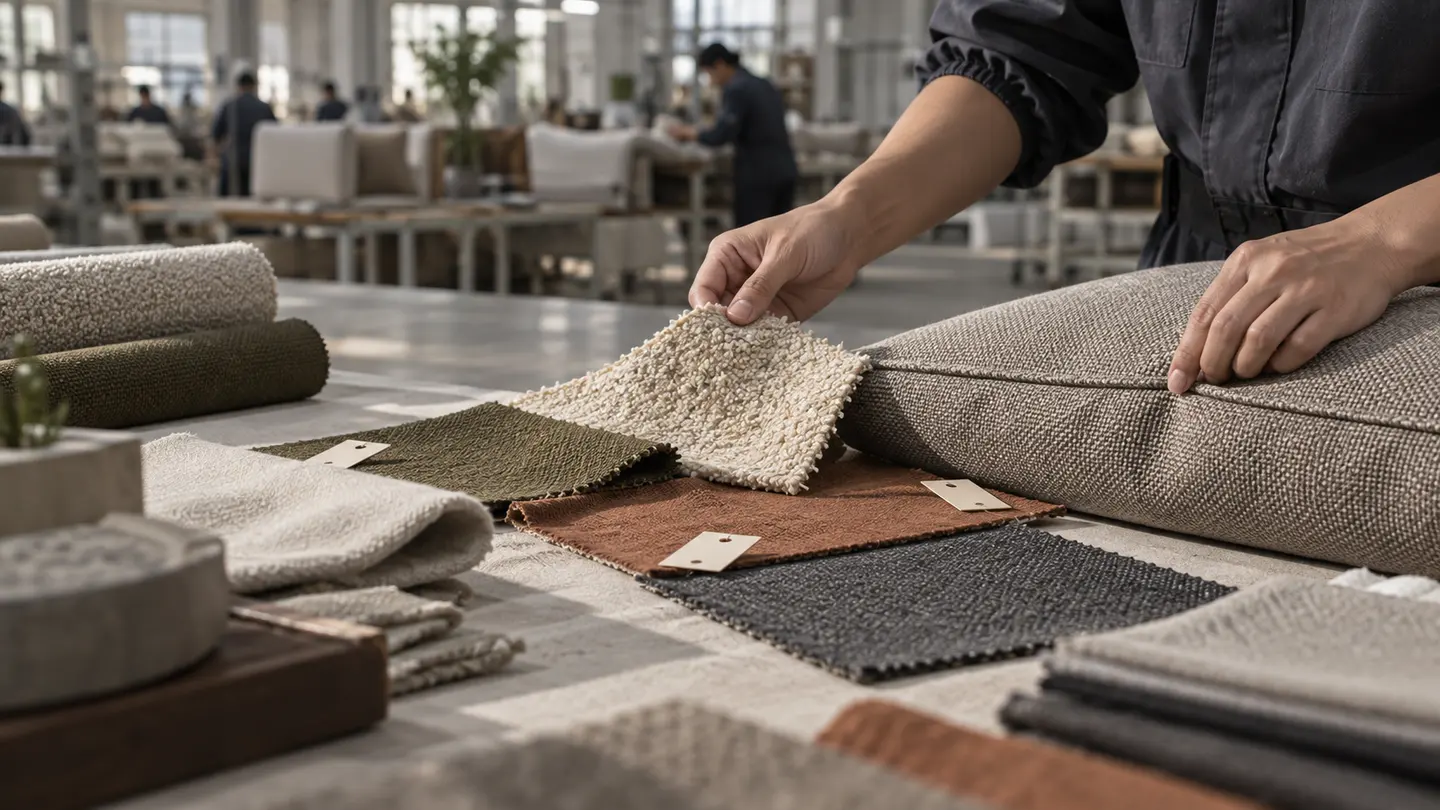
Fabric direction influences colour, texture and how a cover looks across adjacent cushions. Velvet, directional weaves, stripes, plaids and printed fabrics need clear orientation instructions. State whether pattern matching is required at seams, which panel is the visual front and where a repeat should begin. These choices affect cutting yield and MOQ, so they should appear in the quotation.
Approve a full cover sample under relevant light. A stripe that looks centred on a cutting table may not look centred on a filled cushion. For printed pillows, include artwork scale and seam allowance; our printed pillow guide covers this production workflow.
5. Review cover fit with the final filling
Cover fit depends on finished foam or insert dimensions, wrap, compression and fabric stretch. A cover can look correct on a temporary prototype but pull too tightly when bulk fill changes. Approve the actual cover and filling combination. Check profile, corner fill, zipper operation, seams and recovery after normal use and, where relevant, unpacking.
For fitted seat cushions, include the supporting deck and attachment in this review. A non-slip underside, ties or concealed fixture can affect cover tension and edge position. For long bench cushions, inspect adjacent sections together to confirm continuity of piping and pattern direction.
6. Create a cover-detail approval sheet
One concise sheet prevents scattered decisions. Include drawing revision, fabric code, panel layout, cover dimensions, zipper specification, piping, thread, seam positions, labels, underside, attachment and packed presentation. Add close-up approved photos of corners, zipper ends and labels. Mark any approved visual variation or defect threshold clearly.
Factory testing begins by confirming material codes and first-off details against this sheet. In-process checks can focus on cut direction, piping joins, zipper position and visible workmanship. At shipment inspection, assess the finished cushion, labels, SKU count and packing against the retained sample and the same checklist.
PROJECT SUPPORT
Need a cover-detail checklist for a custom cushion?
Send your product drawing, material direction and cleaning needs. We will help organise zipper, piping, seam and fit decisions for the sample.
Review Cover Details →7. Plan cleaning and future service
Cover construction affects what happens after delivery. If covers are removable, retain the material code, section number and fitting notes for replacements. If covers are fixed, specify a realistic cleaning method and identify how a damaged cushion can be handled. For private-label pillows, label placement and care information should support customer use without disrupting the product’s appearance.
Care instructions must follow the actual material guidance. Do not promise that a removable cover is machine washable unless the selected fabric and construction support it. The right service plan can be a spare cover, a replacement section or a professional-cleaning procedure rather than an overbroad claim.
Common cover-construction mistakes
- Approving fabric but not the finished cover around its final fill.
- Leaving zipper location and opening size unspecified.
- Using decorative piping without defining diameter, joins and corner quality.
- Ignoring fabric direction, repeat or visual front.
- Assuming a removable cover is serviceable without testing removal and re-fitting.
- Inspecting only general appearance without close-up seam and closure checks.
Test serviceability before approving the visual finish
A tailored cover should be tested as a service component. Ask a person who did not make the sample to remove and re-fit it using the intended zipper and filling. Check whether the cover returns to its original shape, whether piping remains aligned and whether the closure can be operated without strain. This simple test exposes problems that are invisible when a sample remains permanently filled in a showroom.
For project seating, repeat the test on a representative installed section. Confirm that the cushion can be lifted, the attachment can be accessed and the visual front is restored correctly. If the property will manage replacements, include a short fitting note and section identification in the handover file.
Create a visual workmanship library
Approved close-up photos are useful for details that are hard to describe in words: corner turns, piping joins, zipper ends, stripe alignment, label placement and cover tension. Store these images with the drawing and material code. Mark what is acceptable and what requires correction. This gives sewing and quality teams a practical reference during first-off and in-process inspection.
Use the same library for third-party inspection or incoming project checks. It reduces subjective debates because the buyer has already shown the standard they expect for the finished item.
Control cover changes for replacements and reorders
A replacement cover is a product revision, not merely a piece of fabric. Verify the cover code, fill dimensions, zipper, piping, pattern direction and section number before ordering. If the original fabric is unavailable, approve a physical alternative and update the product file. Do not assume a visually similar fabric will fit or behave the same way over the existing cushion core.
Keeping the original sample, photos and component list makes this process much safer. It helps a hotel, restaurant or retailer preserve a consistent product experience while making deliberate changes when necessary.
Choose cover details around the real service workflow
A zipper, piping edge or removable cover is not a decorative afterthought. Each changes how the cushion is made, cleaned, inspected, packed and replaced. Begin by asking who will use the cushion and who will maintain it. A decorative indoor pillow may use a discreet closure selected for appearance. A hotel bench cover may need a closure position that allows trained staff to remove it without disturbing the full installation. An outdoor piece may need construction choices that work with its intended drying and storage routine. The right answer depends on the complete product application, not on a single preferred hardware name.
On a sample, inspect the closure from both the user and operator viewpoint. Confirm it lies where expected, opens sufficiently for the insert, does not create an uncomfortable pressure point, remains visually tidy and is not likely to snag during normal handling. Examine piping at corners, curves and joins: it should follow the approved shape without excessive waviness, awkward ends or inconsistent seam position. For a patterned cover, agree how piping and seams interact with face direction so the final product reads as intentionally made.
Document serviceability and replacement decisions
If covers are intended to be removable, define the service process in the product file. Include the cover material code, closure type and location, removal direction, insert reference, care instructions, label position and any location code for sectional furniture. Let the receiving or operations team practise removal and refitting on an approved sample where practical. A removable cover does not automatically mean it is suitable for every laundry process; instructions should reflect the selected material and the buyer’s actual cleaning capability.
For projects using non-removable covers, record the approved cleaning method and the condition under which an entire cushion is to be replaced. Consider how the customer will identify the exact item later: SKU, dimensions, finish, location and final photograph are more useful than a generic name. This planning is particularly valuable for banquettes or lounge sets where several similar sections may look alike but are not interchangeable.
Inspect construction details at the points they can fail
At first-off and shipment inspection, check a representative range of closures, piping runs, corners, seam joins, label placement and cover fit. Compare the work with the approved sample, then record the issues that would affect visual quality, serviceability or safety in the intended application. If a component needs changing because of supply availability, review the visual and functional effect before bulk production continues. A comparable zipper length or piping diameter may still change the finished cover behavior.
Retain the approved construction notes with the reorder file. When a buyer later requests extra covers, inserts or replacement cushions, the supplier can reproduce the functional details as well as the visible fabric. This attention to small construction decisions is what makes a custom cushion program manageable after the initial delivery, rather than merely attractive on the day it is photographed.
Use component references to prevent silent construction drift
Keep a small approved component record with the product file: closure type and length, pull direction, piping size and color, seam location, label position and a close-up photograph. This is particularly helpful when a factory buys materials again for a reorder or when two similarly named components are available. If a proposed component is not the original one, assess its effect on appearance, access, durability and packing before it is used.
For visible details, inspect a representative spread across colors, sizes and shapes rather than one convenient unit. Corners, curved sections, patterned panels and long bench runs are where a construction variation is most likely to become noticeable. Recording these checks gives the buyer a defensible basis for approval and gives the factory clear feedback that can be applied before the product reaches the customer.
Align cover construction with packing
Discuss closure and piping protection with the packing team before dispatch. A zipper pull, delicate piping join or decorated front panel can be affected by the way covers are folded, compressed or separated in cartons. Capture the approved arrangement in a packing photograph and inspect it at shipment release. This is a small control that helps the finished construction arrive in the same usable condition that the buyer approved.
Conclusion: control the details customers can see and use
Cover details make a visible difference to custom cushions. Define the cover’s service purpose, specify zipper and seam construction, approve piping and fabric direction, test the complete fit and use one current sheet for production control. This turns delicate-looking details into measurable, repeatable quality requirements.
Photography plan for this guide
Use original factory photography where possible. The prompts below are production references for realistic imagery, not claims about a specific order.
Position: Below the introduction
Caption: Piping, seams and cover tension are assessed on the finished cushion, not as separate trims.
AI prompt: High-resolution photorealistic product-detail shot of a premium tailored cushion: textured woven upholstery, perfectly aligned piping, neat corner seam and subtle concealed zipper edge, soft natural studio light, no logos, no text.

Position: After “Create a cover-detail approval sheet”
Caption: A technician compares zipper position and piping quality with the approved cover-detail reference.
AI prompt: Documentary realistic Shenzhen factory photo: Asian quality technician inspecting the piping and zipper of a custom seat cushion at a clean workstation, visible fabric swatch and small non-readable reference sheet, natural industrial light, no logos.

Position: After “Review cover fit with the final filling”
Caption: Adjacent fitted sections are reviewed together for visual continuity and usable access.
AI prompt: Photorealistic boutique hospitality interior showing adjacent tailored bench cushion sections with aligned piping and refined fabric direction, warm natural daylight, no people, premium commercial styling, no logos or text.
Frequently asked questions
Where should a cushion zipper be placed?
Place it where it supports intended removal and cleaning without disrupting comfort, appearance or weather behaviour. Confirm access and operation on the finished sample and actual furniture where possible.
What is piping on a cushion?
Piping, or welt, is a covered cord detail sewn into a seam. It can create a tailored edge, but material, diameter, joins and corner execution should be specified and approved.
Should all cushion covers be removable?
No. Choose removable covers when the cleaning and replacement workflow needs them. Fixed covers may be appropriate where a tighter profile or construction is preferred; test the service plan in either case.
How do I prevent seams from puckering?
Use the appropriate fabric, cover fit and sewing construction, then inspect a full sample with final filling. Document seam location and visible workmanship expectations for bulk checks.
What should be in a cushion-cover QC checklist?
Include fabric code and direction, cover dimensions, seam position and workmanship, piping, zipper function and placement, labels, fill fit, visual appearance and packing.
Enquiry popup plan
Trigger: Show after 40% scroll, after 30 seconds on page, or on desktop exit intent; suppress after a completed submission.
Popup title: Request a cushion cover review
Copy: Share your cover fabric, product type and service requirements. We will send the construction details to confirm before sampling.
Fields: Required: Name, Email. Optional: Company, Project Type, Message. Do not request a phone number.
Button: Request Cover Review
Approve the details that define finished cushion quality
Email info@cushionnook.com or use the enquiry form to discuss custom cover construction and sample development.
Send Your Requirements →