Last updated: September 17, 2026 · 10–12 minute read
Private Label Throw Pillows: A B2B Guide to Product Development
A private-label throw pillow is more than a printed logo on a finished product. It is a defined SKU system: cover, insert, artwork, label, packaging, quality reference and reorder plan must all support the brand and the sales channel.
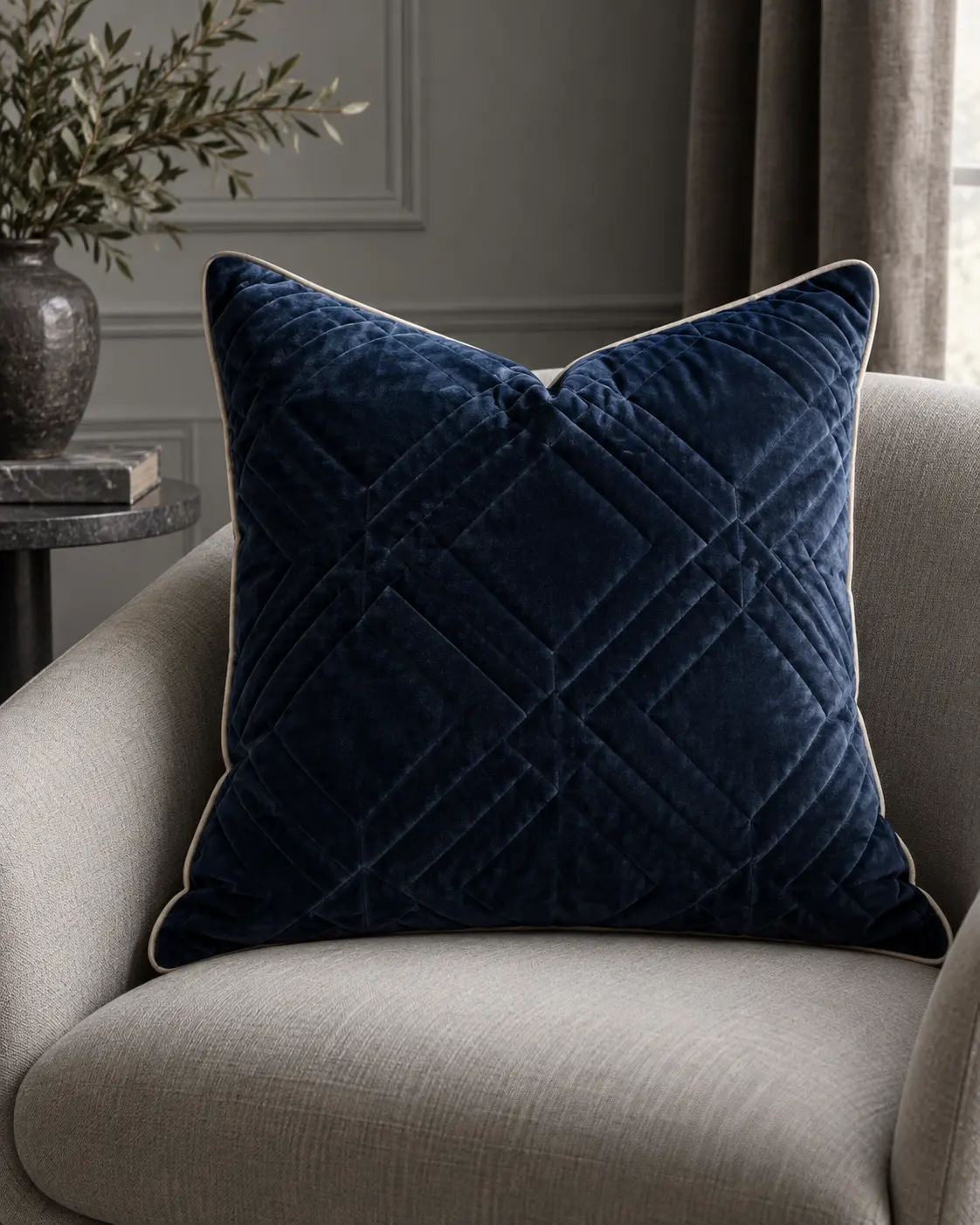
A private-label pillow collection is developed as a complete SKU, from cover and insert to label and packed presentation.
Quick answer: what is needed to develop private-label throw pillows?
Start with a concise assortment brief that defines customer, retail or hospitality channel, size range, cover materials, insert type, colour or artwork, label, packaging, quantity and destination. Then create a physical sample, approve the final SKU details in one controlled record, and use that record for bulk production and shipment inspection.
Private label works best when the buyer locks the customer-facing details early: hand feel, fill recovery, label position, product story, barcode or hangtag requirements and unpacking presentation. These details influence supplier MOQ, lead time and cost as much as the cushion cover itself.
1. Build an assortment before requesting price
A supplier can quote accurately only when it knows what each SKU is. List size, shape, cover front and back, closure, insert, trim, artwork, label, packaging and quantity by colour. Keep the first collection focused. A small number of well-defined core SKUs is easier to sample, merchandise and reorder than many low-volume variations with different materials and cartons.
Consider how items work together on shelf or in a styled setting. A collection may share one base fabric, insert type, zipper location and carton family while varying colour, print or size. This can simplify material minimums and quality control without making the range look repetitive. See our MOQ guide for how fabric, labels and cartons influence the viable order.
Private-label SKU fields
- Product name, internal SKU, finished size and shape.
- Cover fabric supplier, code, colour, print or embroidery reference.
- Insert material, fill weight or construction, and expected loft.
- Zipper, piping, tassel or other trim details.
- Brand label, care label, hangtag, barcode and packaging requirements.
- Quantity, destination, sales channel and requested delivery date.
2. Decide the cover and insert together
The cover gives the pillow its visual identity; the insert creates its hand feel, shape and recovery. A textured cover may need a fuller insert to look considered. A highly tailored square cover may need an insert size and fill that gives clean corners without over-stressing seams. A premium decorative pillow and a high-volume retail pillow may have different packaging and recovery requirements.
Review the completed sample, not individual components. Check the cover’s fit over the insert, zipper opening, seam tension, pattern placement, corner profile and the way the pillow looks after unpacking and light use. Retain the approved sample as the reference for bulk quality control. The sample process guide explains how to control revisions.
3. Treat branding as a construction detail
Labels, hangtags and packaging should be specified with the same care as fabric. State label type, dimensions, fold, material, placement, artwork file, care information and attachment method. A woven side label, printed care label, branded zipper pull and hangtag all have different supplier minimums and production paths. Confirm which components are final before bulk production begins.
Design labels for the customer experience and legal information required in the destination, but do not assume generic label wording is suitable everywhere. Check destination requirements with appropriate qualified sources or advisors. The factory should confirm what it can apply, while the buyer retains responsibility for brand content and market-specific claims.
4. Plan packaging for retail and export separately
Individual presentation and outer export protection are different jobs. A retail insert card, polybag, belly band or hangtag may support shelf presentation; the master carton needs to protect the product through handling and make receiving accurate. Specify whether pillows are compressed, how they should recover, carton quantity, carton marks and whether mixed SKUs are allowed.
Before committing branded cartons, consider the first-run quantity and product life cycle. A standard protective carton with a controlled label can be more flexible for a new launch. Once the assortment is proven, printed retail packaging may become commercially sensible. Our packaging guide covers the details to compare.
5. Control artwork and colour approval
For printed or embroidered pillows, send production-ready artwork and a placement drawing. Confirm repeat, scale, front/back orientation, colour reference and any exclusion zones near seams or zippers. Do not approve only a screen image; inspect a physical strike-off or finished sample under normal lighting. Fabric texture and print method affect perceived colour and detail.
For solid or woven covers, retain an approved swatch and state the exact material code. Discuss availability and colour continuity before planning a reorder. A private-label collection needs a realistic approach to future supply; promising an exact match without material continuity is not responsible sourcing.
6. Approve sample, first-off and shipment evidence
The approval record should contain the current drawing or SKU sheet, material and insert references, artwork proof, labels, packing sample, measurements and product photographs. Mark each SKU approved, approved with conditions or pending revision. If an element changes, issue a new revision rather than relying on a message history.
Factory testing and first-off inspection should compare bulk work with the golden sample. Typical checks include cover and insert codes, finished size, fill distribution, seam and zipper workmanship, pattern or label placement, barcode or hangtag accuracy, packed appearance and carton count. During shipment inspection, verify SKU mix and export marks against the purchase order.
PROJECT SUPPORT
Need a private-label pillow development brief?
Send your collection concept, sizes, material direction, target quantity and destination. We will help organise the SKU and sampling questions before quotation.
Develop a Private-Label Collection →7. Set up a reorder path before launch
Save the approved sample, material codes, artwork files, label source files, packing configuration and inspection record. Establish which components are stock-supported, which have minimums and how residual fabric is handled. This makes it easier to replenish successful colours or create coordinated extensions without rebuilding the product from memory.
For retail buyers, track each SKU through the first launch: returns, customer comments, unpacking recovery and damage observations. These are useful inputs for a second order. A carefully documented first production can make a reorder simpler and more consistent than the original development cycle.
Common private-label pillow mistakes
- Requesting price before defining insert, label and packing details.
- Approving cover fabric and insert separately rather than as a finished pillow.
- Leaving label position or artwork scale to production interpretation.
- Buying premium retail packaging before testing the collection’s sell-through.
- Failing to retain material codes, approval samples and artwork files for reorders.
- Making market or material claims without appropriate evidence.
Manage the collection as controlled SKU data
Once a private-label range is approved, maintain one SKU master record for every pillow. It should connect product name, size, cover code, insert build, artwork, label, hangtag, packaging, carton quantity, approved sample and current status. This avoids a common launch problem: marketing, warehouse and factory teams using similar but different names for the same item.
Make the SKU master the reference for customer-facing data as well. Product copy, care information, barcode, photography and pack details should match the approved physical item. If a cover or insert changes, issue a new revision and decide whether the SKU, listing or packaging information needs to change too. This protects brand consistency and prevents a correct pillow from being shipped with an inaccurate label or listing.
Run a channel-readiness review
Before launch, inspect the product as the customer or receiving team will encounter it. For retail, check shelf presentation, hangtag, barcode scan, unpacking recovery and product photography. For hospitality, check installation, room or zone identity, care note and replacement process. For e-commerce, confirm that dimensions, material description and care guidance reflect the exact approved SKU.
Use a small pilot or pre-launch receiving check when the channel is new. Capture any issue with pack damage, recovery, labelling or customer interpretation and feed it into the final packing or product record. This is practical first-hand experience that makes later production more reliable.
Review reorder performance deliberately
After the first sales or installation cycle, review sell-through, returns, customer feedback, packing damage, recovery observations and replacement requests. Link findings to the SKU rather than making a broad statement about the collection. A successful colour may justify material planning for a reorder; a recurring label or fill issue may require a revised sample before the next run.
Share the decision with the factory as a controlled update. Preserve the original record, add the changed component and approve the revised first-off when necessary. This gives a growing brand a repeatable development system instead of treating every order as a new conversation.
Build a private-label SKU architecture before adding options
A private-label pillow range becomes difficult to manage when every color, size, fill, trim and pack format is treated as a separate informal request. Start with a defined SKU architecture. For each product, state the finished size, cover material and color reference, print or embroidery revision if applicable, insert type, closure, label placement, care information, individual packing and master-carton quantity. Then decide which elements are fixed across the range and which may vary by channel or season. This gives the factory a stable development file and gives the buyer a clearer view of inventory and reorder risk.
Range planning should also reflect the route to market. A boutique homeware collection may prioritize tactile cover quality, coordinated colors and presentation packaging. An e-commerce program may require barcode placement, compact cartons, pack-out consistency and product images that match the delivered SKU. A hospitality gift or promotional program may need a branded label, a deadline and a specific delivery configuration. The same pillow form can therefore require different commercial controls depending on the customer requirements and final application.
Approve brand assets as production assets
Logo files, artwork, care labels, hangtags and carton marks should be released in a format the production team can use. Keep the approved version, dimensions, color direction, placement reference and language requirements together with the product specification. If a label is woven, printed or sewn into a seam, review it on the physical sample rather than approving only a screen proof. Check that it is readable, correctly orientated and positioned without compromising comfort or cover fit.
For printed or patterned covers, create a visual placement reference showing the front, back, closure side and face direction. This reduces the chance that an otherwise correct pillow ships with a rotated motif or label on the wrong edge. At shipment inspection, compare selected finished products and cartons with the approved pack: SKU name, label, artwork revision, packing count and barcode or carton mark where applicable. These checks protect brand consistency at the point where the customer first sees the product.
Use a controlled reorder process
Private label programs are often successful because they can be replenished. Keep an approved master sample or detailed photo record, the final bill of materials, fill direction, packaging standard and customer approval notes. On every reorder, confirm the quantity by SKU, destination, current label artwork, required delivery date and any material availability change. Do not assume that a previous color, insert or carton remains identical without checking the current production file.
When a new variation is introduced, decide whether it is a new SKU or a revision of an existing one, then document that decision. Clear SKU governance supports more accurate quotes, smoother factory handover and fewer warehouse errors. It also gives a buyer evidence that the range is being managed as a repeatable product program rather than a series of unrelated custom pillow requests.
Check the range at the point of customer presentation
Before a private-label launch, inspect a packed and unpacked sample as the end customer will see it. Confirm the correct SKU name, cover appearance, label, care information, insert feel, hangtag or barcode, individual protection and carton mark. Compare product photography and catalog descriptions with the approved physical item so that size, color direction, material language and included components are not misleading. This final review is especially valuable for online sales, where a customer cannot touch the pillow before ordering.
Assign one approved reference set to the brand team and one to the production file. When new sales channels request different labels, bundles or packs, treat those as controlled versions rather than modifying a familiar item informally. This discipline supports consistent product presentation, cleaner warehouse handover and faster resolution if a retailer asks for an exact replacement or updated documentation.
Conclusion: make every SKU repeatable
A strong private-label pillow program turns brand intent into a controlled product file. Define the assortment, approve cover and insert together, specify labels and packing, use samples as the quality reference and preserve records for reorders. This gives brands a more dependable path from concept to a customer-ready collection.
Photography plan for this guide
Use original factory photography where possible. The prompts below are production references for realistic imagery, not claims about a specific order.
Position: Below the introduction
Caption: A private-label pillow collection is developed as a complete SKU, from cover and insert to label and packed presentation.
AI prompt: Photorealistic premium lifestyle editorial: coordinated private-label throw pillows in varied textured neutral fabrics on a contemporary sofa, refined European-American interior, soft natural daylight, no visible logos, high-end B2B product-development visual.

Position: After “Approve sample, first-off and shipment evidence”
Caption: A technician compares a finished pillow with the approved cover, label and packing references.
AI prompt: Realistic Shenzhen factory quality-control photo: Asian technician checking a finished throw pillow beside fabric swatches and a small blank label reference, clean workstation, authentic textile texture, natural light, no readable logos or text.

Position: After “Plan packaging for retail and export separately”
Caption: Finished pillows are protected and counted for export while individual presentation details remain controlled.
AI prompt: Photorealistic B2B packing scene in a clean Shenzhen soft-furnishing factory: finished throw pillows in simple protective bags beside plain export cartons, Asian staff reviewing packing count, natural industrial light, no brands or readable text.
Frequently asked questions
What is private-label throw pillow manufacturing?
Private-label manufacturing produces pillows under the buyer’s brand using an agreed SKU specification for cover, insert, labels, packaging and quality. The buyer typically controls brand and assortment decisions while the factory supports sampling and production.
What should be on a private-label pillow label?
Specify brand label, care information, material content and any required destination-market details with qualified advice. Record label size, material, placement and attachment in the approved SKU file.
How do I choose a throw pillow insert?
Choose it with the cover and intended sales position in mind. Review the assembled sample for loft, shape, corner fill, hand feel, recovery after unpacking and seam tension.
Can private-label pillows use custom printed fabric?
Yes, but print setup, colour proofing, repeat and material minimums should be confirmed early. Approve a physical proof or finished sample before bulk production.
How can I make pillow reorders consistent?
Retain the approved sample, material and fill codes, artwork, label files, packing configuration and inspection record. Confirm material availability and any residual-fabric arrangement before the first order closes.
Enquiry popup plan
Trigger: Show after 40% scroll, after 30 seconds on page, or on desktop exit intent; suppress after a completed submission.
Popup title: Start a private-label pillow brief
Copy: Share your collection direction and target channel. We will send the key cover, insert, label and packing fields to confirm.
Fields: Required: Name, Email. Optional: Company, Estimated Quantity, Message. Do not request a phone number.
Button: Start Collection Review
Turn your pillow concept into a controlled SKU system
Email info@cushionnook.com or use the enquiry form to discuss custom throw pillow sampling, labels and export packing.
Ask for Product Catalog →