Last updated: September 17, 2026 · 10–12 minute read
Outdoor Cushion Fabric Comparison: Acrylic vs. Olefin vs. Polyester
Acrylic, olefin and polyester are useful starting categories for outdoor upholstery, but the finished cushion depends on the exact fabric construction, finish, cover design and site conditions. This buyer guide helps hospitality, retail and furniture teams compare options without relying on broad material claims.
Outdoor cushion fabric should be selected for the site, cleaning routine and completed cushion construction.
Quick answer: which outdoor cushion fabric is best?
No single fabric is best for every outdoor cushion. Acrylic, olefin and polyester can each be suitable when the exact construction, colour method, finish, exposure and care routine match the project. For a highly exposed pool terrace, colour retention and drying strategy may lead the decision. For a covered restaurant patio, cleanability, hand feel and cost may matter more. For a retail collection, the balance may include appearance, reorder continuity and packaging.
Compare named fabric options against the real application, then approve the proposed cover as part of a complete sample. A fabric swatch cannot prove cushion drainage, zipper protection, fill recovery or how the colour looks at the intended site.
1. Start with exposure, not a material name
Map the location before asking for fabric options. Record direct sun hours, rain exposure, salt or pool splash, airborne dust, tree debris, humidity, ventilation, seasonal storage and cleaning practice. A cushion under a deep hotel canopy faces a different risk profile from one left beside an open pool all day. The same material can give different service results in those environments.
Also identify how the cushion will be used. A decorative back pillow, a dining chair pad and a deep lounge seat carry different loads and cover tension. Fabric choices must work with the filling and construction. An otherwise suitable cover that traps water around a slow-drying core will not create a quick-dry cushion simply because it has an outdoor label.
Useful project questions
- Will cushions remain outdoors during rain, or be collected by staff?
- How long does direct sun reach the seating area in peak season?
- Will food, sunscreen, chlorinated water or saltwater be likely contaminants?
- Can the operator air-dry, brush, spot-clean or machine-wash covers?
- Are replacement covers planned, and must a colour remain available for future orders?
2. Acrylic: often selected for colour and soft upholstery character
Acrylic upholstery is frequently considered where a project wants a soft textile feel and sustained appearance in sunny conditions. Many outdoor acrylic fabrics use colouration methods designed for colour retention, but buyers should request the exact manufacturer’s information for the selected fabric rather than assuming every acrylic performs alike. Weight, weave, finish, backing, cleaning guidance and colour can all influence the result.
Acrylic can be a strong option for resort lounges, upscale terraces and retail collections where hand feel, texture and a broad colour palette matter. Confirm how the chosen weave handles seam tension, piping and removable-cover construction. Textured surfaces may need a care plan that addresses dust and debris; light colours may require an operator-ready cleaning routine.
Ask about shade continuity for large runs and reorders. If cushions will be placed side by side, fabric allocation by roll can matter visually. Retain a labelled approval swatch with the golden sample, and do not describe a colour as permanent or stain-proof without product-specific evidence.
3. Olefin: useful where moisture, colour and value must be balanced
Olefin is often considered for outdoor cushions because it can offer useful colour and moisture-related characteristics at a commercially attractive position. Its performance still depends on yarn, construction and finish. A flat woven, a textured weave and a fabric with a backing may behave differently in hand feel, drying, seam behaviour and cleaning. Ask the fabric supplier for the technical data and care guidance for the exact code.
For hospitality projects, evaluate whether olefin provides the appearance and cleaning workflow required by the design. Some uses benefit from its practical nature, while premium interior-adjacent spaces may need a particular texture or drape that should be reviewed in full scale. Assess the cover over the selected foam or filling; cover tension and fabric stretch influence the tailored profile.
4. Polyester: broad choice, but specify the construction carefully
Polyester appears in a wide range of upholstery fabrics, including fabrics marketed for outdoor or covered-outdoor use. Because the category is broad, “polyester” is not a specification. The buyer needs the fabric supplier, construction, finish, colour method, backing, care method and intended exposure. Some polyester options are attractive for design flexibility and cost; others are selected for a particular texture, print or performance finish.
When comparing polyester with acrylic or olefin, avoid asking which fibre is universally superior. Compare the actual swatches and technical information against the location. Check whether the selected fabric needs more protected placement, whether water-repellent finish needs periodic maintenance, and whether the expected cleaning approach is compatible with the finish. Use a sample under representative light because colour and surface sheen can change outdoors.
5. Compare fabrics as a finished cushion system
A cover fabric is only one part of an outdoor cushion. Seams, zippers, piping, underside, filling, venting, drainage and storage all influence whether a cushion remains serviceable after weather. A water-repellent face fabric can still be paired with a construction that retains moisture. Conversely, a well-planned cover, quick-dry filling and drainage strategy can improve practical drying even when no unrealistic “fully waterproof” claim is made.
Use the factory sample to test the practical questions: does water collect at the zipper line? Does the cover fit neatly after the filling recovers? Can staff remove the cover if designed to do so? Is the underside appropriate to the furniture? Does the cushion dry acceptably in the project’s expected conditions? Our waterproof versus water-resistant guide and quick-dry construction guide cover the system decisions in detail.
A buyer comparison sheet should include
- Exact fabric supplier, code, colour, construction and current technical documentation.
- Proposed application, sun/rain exposure and cleaning procedure.
- Cover construction: seams, zipper, piping, backing, underside and attachment.
- Filling construction and how water is expected to leave the completed cushion.
- Sample review result, colour reference, care guidance and reorder availability discussion.
6. Review colour, print and texture under real conditions
Outdoor light is a demanding reviewer. A swatch that appears balanced indoors can look brighter, cooler or more reflective in sun. Lay a larger cutting on the intended furniture, compare it with adjacent materials and view it at several times of day. For prints and stripes, confirm direction, repeat, scale and pattern placement on the actual cushion shape.
Colour approval should be a controlled decision. Note the fabric code and current dye lot information if available, retain a signed swatch and agree what constitutes acceptable variation. For large orders, ask how the factory will allocate roll lots across neighbouring cushions. For reorders, confirm availability rather than promising an exact future match that the material supplier has not guaranteed.
7. Build cleaning and maintenance into the material decision
Outdoor cushions need a care instruction matched to their actual material. Generic advice is weak because aggressive cleaners, bleach, high heat or prolonged wet storage may be unsuitable for a selected cover or filling. Ask the fabric supplier for care guidance and translate it into an operator-friendly routine: brush debris, address spills promptly, rinse only where appropriate, promote drying and store when weather or seasonal closure makes that sensible.
For hotels and resorts, a small replacement-cover strategy can be more practical than trying to rescue every heavily marked cover. Identify SKUs, colour references and installation orientation so maintenance teams can order and fit replacements accurately. See our outdoor cushion care guide for a framework that can be tailored to the final material.
8. Approve with evidence, not broad claims
Request the applicable technical information from the selected fabric supplier and make sure it corresponds to the material that will actually be used. If a project requires a particular test, standard or environmental documentation, verify scope, date and applicability with the appropriate party. Do not generalise a result from one fabric into a claim about every cushion in a collection.
During factory testing and sample approval, verify material codes before cutting, compare the first-off cover to the approved swatch, inspect pattern direction and seams, and confirm the final care and packing information. Shipment inspection should check that SKU mix, cover materials, labels and cartons match the approved order. This creates a traceable link from selection to handover.
PROJECT SUPPORT
Need to compare outdoor fabric options for a real project?
Send your exposure conditions, target style, furniture type and care routine. We will help structure the fabric and cushion-construction questions for sampling.
Compare Material Options →Build a site-exposure matrix before selecting a fabric
Instead of grouping every exterior space as “outdoor,” rank seating locations by exposure. A covered balcony, an open roof terrace, a pool deck, a beach-adjacent lounge and a seasonal restaurant patio expose cushions to different combinations of sun, rain, humidity, splash, dust and storage. A simple exposure matrix makes these differences visible to design, procurement and operations teams.
For each zone, state direct sun pattern, rain response, contaminants, furniture deck, cleaning method and whether staff remove cushions. Then list the candidate fabric codes and the finished cushion construction to be sampled. This makes it easier to see why an acrylic, olefin or polyester option may be suitable in one zone but not another, without presenting any fibre as universally superior.
Use a material trial matrix
When two or three fabrics remain possible, make comparable finished samples. Use the same cushion size, fill and cover construction where practical. Review texture and colour in situ, check the cover after normal use, document cleaning observations according to the supplier guidance and record any drying or maintenance issue. The goal is not an informal “winner”; it is a decision record showing why a particular code was selected for a specific application.
Include operators in the review. A design team may prefer one texture while housekeeping may identify a different cleaning or debris issue. Both observations are valid. The final material choice should reflect the agreed product experience and the property’s ability to maintain it.
Write performance language that matches evidence
Once a fabric is selected, use specific language in product copy and project documents. Name the fabric code or category, intended exposure and care approach. Avoid phrases such as “weatherproof,” “fade-proof” or “maintenance-free” unless the exact scope and evidence are clear. For a custom finished cushion, separate fabric information from claims about seams, filling and complete-cushion behaviour.
Retain the approved swatch, sample photos and material information with the order. At reorder time, confirm availability and current technical guidance instead of assuming an old description or report still applies. This supports reliable internal communication and gives AI-search readers clear, source-aware information rather than generic promotional claims.
Compare fabric options using the actual exposure profile
Fabric names alone do not tell a buyer how a finished cushion will behave. Create a site exposure profile before asking suppliers to compare options: direct or indirect sun, hours of use, rain direction, pool or salt exposure, food and beverage contact, ventilation under the cushion, cleaning equipment, storage practice and expected replacement cycle. A covered rooftop dining area and an uncovered coastal lounge may both be described as “outdoor,” yet the priority order for color retention, drying, cleanability, abrasion, feel and cost can be quite different.
Then ask each supplier to identify the exact proposed material, construction and available technical information. Separate component-level information from finished-product performance. A fabric’s published characteristics are useful inputs, but the complete cushion also depends on seams, backing, zipper orientation, fill, drainage or airflow design, fit on furniture and the venue’s care routine. This framing produces a more honest comparison and helps the buyer avoid a broad promise that cannot be verified for the final configuration.
Use a weighted decision matrix, then sample the leading options
A simple matrix can turn a subjective choice into a clear team decision. List the factors that matter for the project—appearance, color direction, hand feel, cleaning route, moisture management, sunlight exposure, expected service intensity, availability, lead time and budget—and agree a relative weight for each. Score only on evidence available for the proposed material and sample; mark unknowns rather than inventing certainty. The purpose is not to prove one fabric is best in every situation, but to show why a given option fits this site and product application.
For the two leading candidates, request sample covers or representative finished cushions. Review them under the site’s expected lighting and on the actual furniture. Where reasonable, ask the operations team to perform the intended wipe-down or removable-cover routine on a spare sample according to the approved care direction. Check how the cover refits, how seams look under tension and how the cushion is handled when it is damp. Record observations as site-specific feedback, not as a substitute for controlled product testing.
Protect the chosen fabric through purchasing and repeat orders
Once a material is selected, lock its information into the approved product file: supplier or material code, color reference, face direction, backing or finish details, approved sample photos and any relevant documentation. If the buyer requires color approval, define the practical reference and review method; photographs alone can be misleading because light and screens vary. During production, inspect visible face direction, shade grouping, seam alignment and construction details against the released sample.
For later replenishment, confirm whether the original material remains available and whether a new lot needs an updated approval. Avoid promising exact visual continuity across all future production without a defined control method. A transparent process—site profile, comparative sample, recorded choice and controlled reorder check—gives property teams a stronger basis for balancing design intent, maintenance reality and procurement risk.
Conclusion: select a fabric for the site and system it will serve
Acrylic, olefin and polyester each offer useful options for outdoor cushion development. The better purchasing decision comes from defining exposure and maintenance first, then comparing named fabrics in a finished sample with the selected construction and filling. This approach helps teams choose for real service conditions, document what was approved and plan for maintenance and reorder without overpromising performance.
Photography plan for this guide
Use original factory photography where possible. The prompts below are production references for realistic imagery, not claims about a specific order.
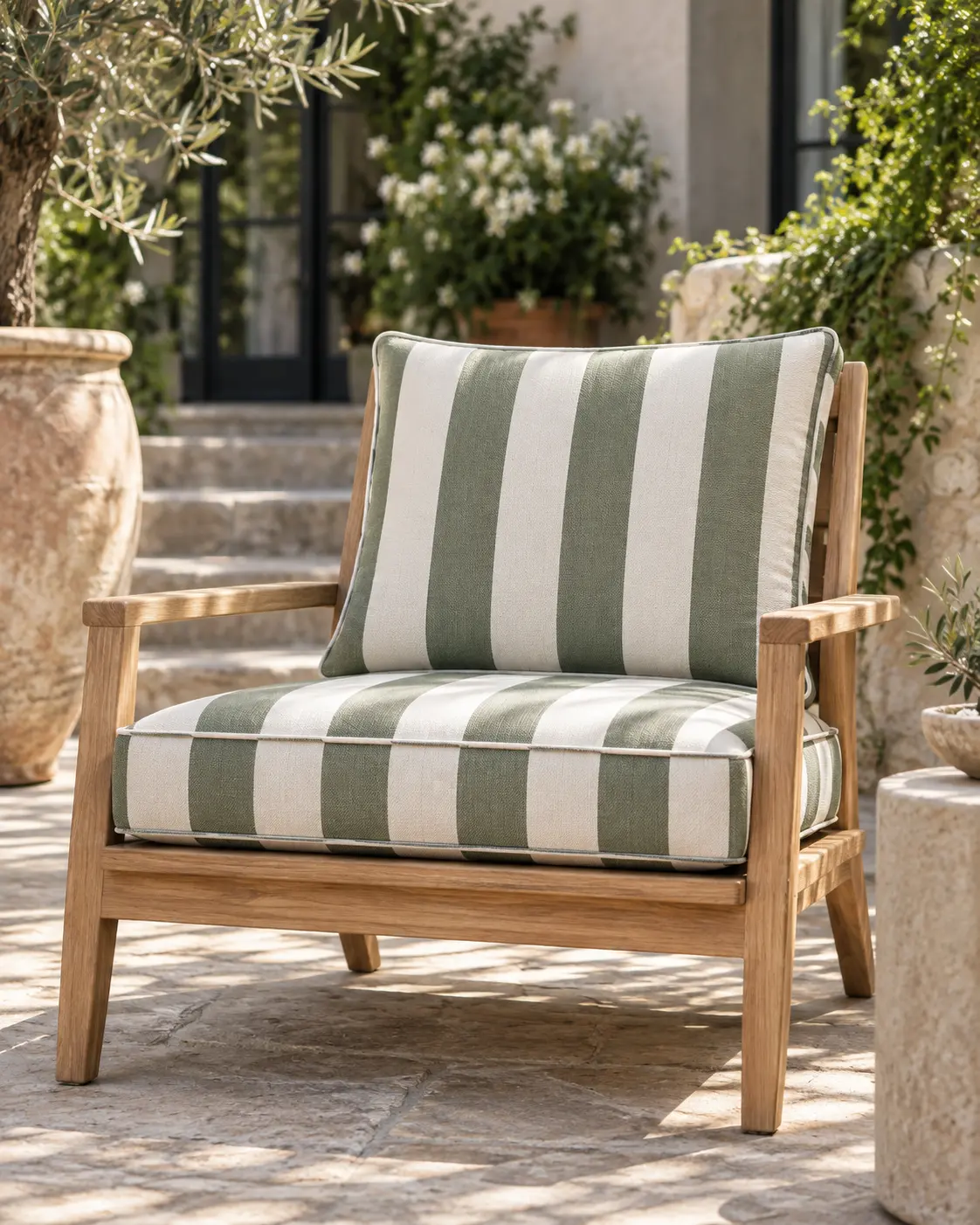
Position: Below the introduction
Caption: Outdoor cushion fabric should be selected for the site, cleaning routine and completed cushion construction.
AI prompt: Photorealistic luxury hospitality terrace in warm daylight with tailored outdoor lounge cushions in textured neutral fabric, realistic poolside landscaping, premium European-American design aesthetic, no people, authentic shadows and textile detail, no logos, no text, 16:9.
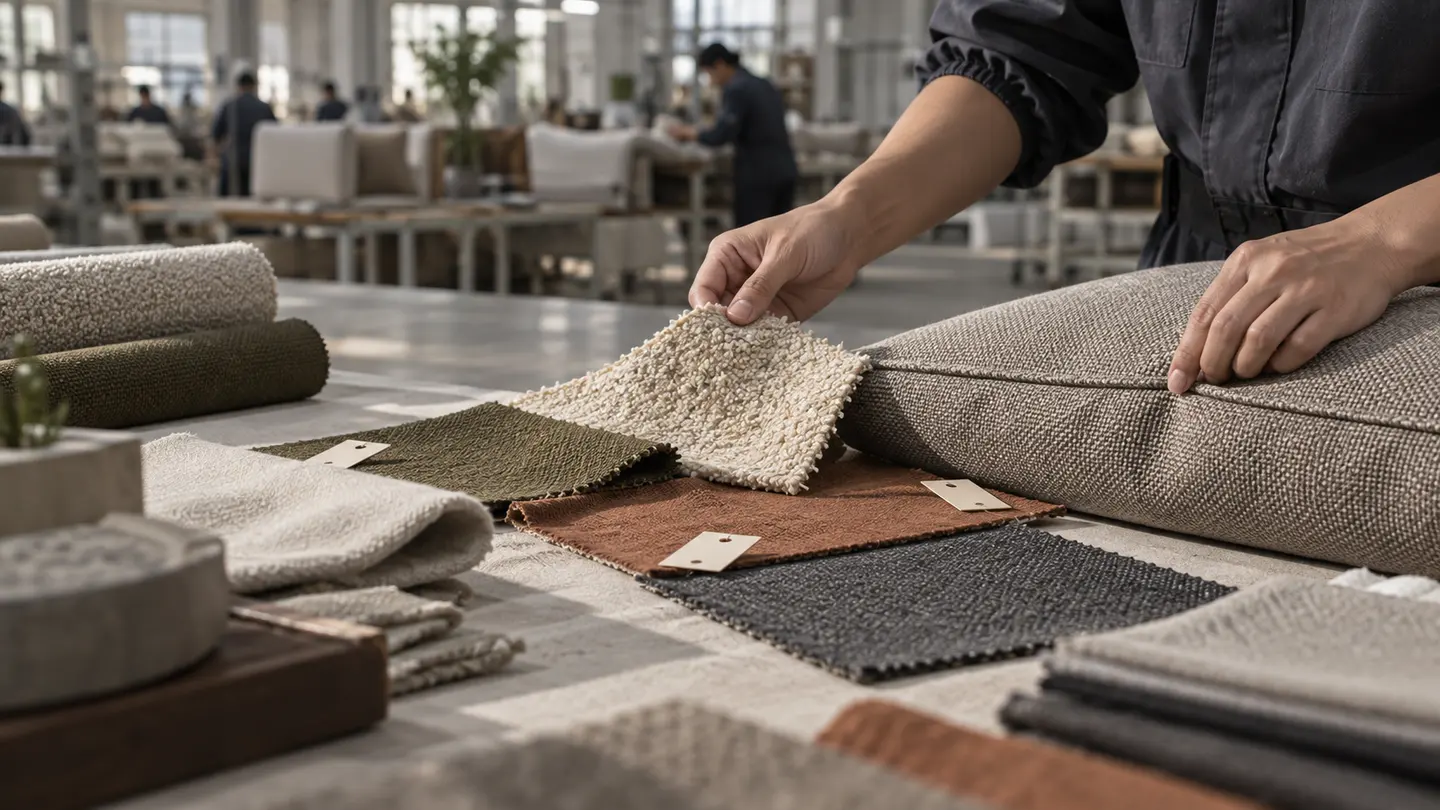
Position: After “Compare fabrics as a finished cushion system”
Caption: Material comparison begins with named fabrics, then continues with a finished-cover sample.
AI prompt: High-resolution realistic product photography of three unbranded outdoor upholstery fabric swatches with clearly different weave textures on a clean neutral table, subtle water droplets on one sample, natural side light, editorial B2B material comparison style, no text or logos.
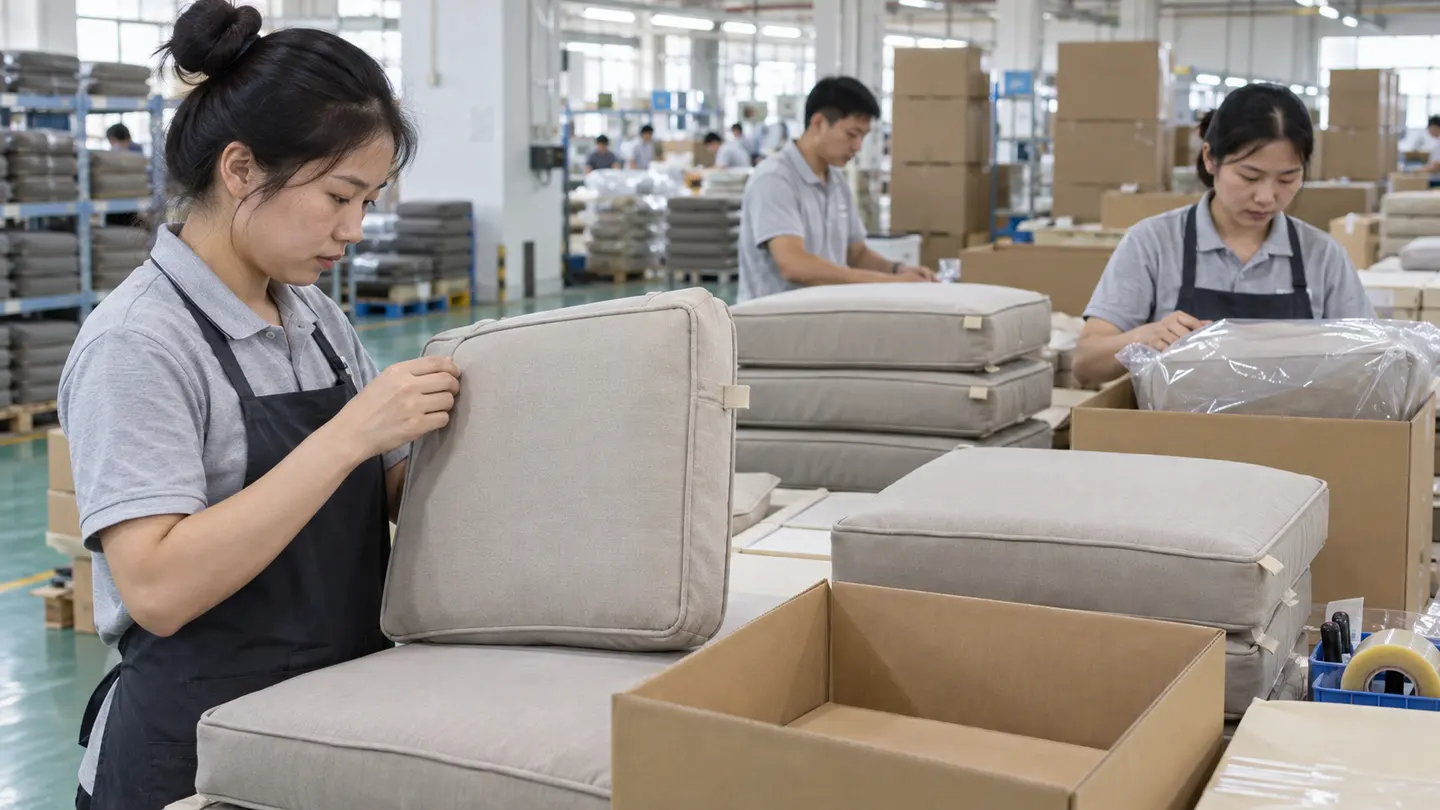
Position: After “Approve with evidence, not broad claims”
Caption: A quality technician confirms the approved fabric reference before production cutting begins.
AI prompt: Documentary photorealistic Shenzhen factory image: Asian quality inspector comparing a small outdoor fabric swatch with a finished cushion cover at a clean workstation, authentic seam and woven texture, soft industrial daylight, no logos, no readable text.
Frequently asked questions
Is acrylic better than olefin for outdoor cushions?
Not universally. Acrylic and olefin can each suit outdoor projects depending on the exact fabric, site exposure, desired hand feel, cleaning routine, cost and construction. Compare named fabric codes in a finished sample.
Is polyester suitable for outdoor cushions?
Some polyester upholstery fabrics are designed for outdoor or covered-outdoor applications, but polyester alone is not a performance specification. Confirm the exact construction, finish, intended exposure and care guidance with the fabric supplier.
What is the best fabric for poolside cushions?
Choose based on sun, water exposure, drying plan, cleaning routine and design needs. Review the complete cushion system, including seams, closure, filling and drainage, rather than selecting the cover in isolation.
Does water-resistant fabric make a cushion waterproof?
No. Water resistance of the cover does not determine how a complete cushion behaves at seams, zippers, filling or underside. Use precise claims and assess moisture management in the assembled sample.
How do I keep outdoor cushion colours consistent?
Approve an exact fabric code and retained swatch, review larger cuttings in outdoor light, ask how dye lots will be allocated across the order and confirm fabric availability before reorders.
Enquiry popup plan
Trigger: Show after 40% scroll, after 30 seconds on page, or on desktop exit intent; suppress after a completed submission.
Popup title: Compare outdoor cushion fabrics
Copy: Share your site conditions and material direction. We will send a concise comparison checklist for cover, filling, care and sampling.
Fields: Required: Name, Email. Optional: Company, Project Type, Message. Do not request a phone number.
Button: Request Fabric Comparison
Build an outdoor cushion sample around the right fabric
Email info@cushionnook.com with your outdoor seating brief or use the enquiry form to discuss materials, construction and sampling.
Send Your Requirements →